
Get trending papers in your email inbox once a day!
Get trending papers in your email inbox!
Subscribe


Paint-it: Text-to-Texture Synthesis via Deep Convolutional Texture Map Optimization and Physically-Based Rendering
We present Paint-it, a text-driven high-fidelity texture map synthesis method for 3D meshes via neural re-parameterized texture optimization. Paint-it synthesizes texture maps from a text description by synthesis-through-optimization, exploiting the Score-Distillation Sampling (SDS). We observe that directly applying SDS yields undesirable texture quality due to its noisy gradients. We reveal the importance of texture parameterization when using SDS. Specifically, we propose Deep Convolutional Physically-Based Rendering (DC-PBR) parameterization, which re-parameterizes the physically-based rendering (PBR) texture maps with randomly initialized convolution-based neural kernels, instead of a standard pixel-based parameterization. We show that DC-PBR inherently schedules the optimization curriculum according to texture frequency and naturally filters out the noisy signals from SDS. In experiments, Paint-it obtains remarkable quality PBR texture maps within 15 min., given only a text description. We demonstrate the generalizability and practicality of Paint-it by synthesizing high-quality texture maps for large-scale mesh datasets and showing test-time applications such as relighting and material control using a popular graphics engine. Project page: https://kim-youwang.github.io/paint-it


WildGS-SLAM: Monocular Gaussian Splatting SLAM in Dynamic Environments
We present WildGS-SLAM, a robust and efficient monocular RGB SLAM system designed to handle dynamic environments by leveraging uncertainty-aware geometric mapping. Unlike traditional SLAM systems, which assume static scenes, our approach integrates depth and uncertainty information to enhance tracking, mapping, and rendering performance in the presence of moving objects. We introduce an uncertainty map, predicted by a shallow multi-layer perceptron and DINOv2 features, to guide dynamic object removal during both tracking and mapping. This uncertainty map enhances dense bundle adjustment and Gaussian map optimization, improving reconstruction accuracy. Our system is evaluated on multiple datasets and demonstrates artifact-free view synthesis. Results showcase WildGS-SLAM's superior performance in dynamic environments compared to state-of-the-art methods.





GS-SLAM: Dense Visual SLAM with 3D Gaussian Splatting
In this paper, we introduce GS-SLAM that first utilizes 3D Gaussian representation in the Simultaneous Localization and Mapping (SLAM) system. It facilitates a better balance between efficiency and accuracy. Compared to recent SLAM methods employing neural implicit representations, our method utilizes a real-time differentiable splatting rendering pipeline that offers significant speedup to map optimization and RGB-D re-rendering. Specifically, we propose an adaptive expansion strategy that adds new or deletes noisy 3D Gaussian in order to efficiently reconstruct new observed scene geometry and improve the mapping of previously observed areas. This strategy is essential to extend 3D Gaussian representation to reconstruct the whole scene rather than synthesize a static object in existing methods. Moreover, in the pose tracking process, an effective coarse-to-fine technique is designed to select reliable 3D Gaussian representations to optimize camera pose, resulting in runtime reduction and robust estimation. Our method achieves competitive performance compared with existing state-of-the-art real-time methods on the Replica, TUM-RGBD datasets. The source code will be released soon.


V2M4: 4D Mesh Animation Reconstruction from a Single Monocular Video
We present V2M4, a novel 4D reconstruction method that directly generates a usable 4D mesh animation asset from a single monocular video. Unlike existing approaches that rely on priors from multi-view image and video generation models, our method is based on native 3D mesh generation models. Naively applying 3D mesh generation models to generate a mesh for each frame in a 4D task can lead to issues such as incorrect mesh poses, misalignment of mesh appearance, and inconsistencies in mesh geometry and texture maps. To address these problems, we propose a structured workflow that includes camera search and mesh reposing, condition embedding optimization for mesh appearance refinement, pairwise mesh registration for topology consistency, and global texture map optimization for texture consistency. Our method outputs high-quality 4D animated assets that are compatible with mainstream graphics and game software. Experimental results across a variety of animation types and motion amplitudes demonstrate the generalization and effectiveness of our method. Project page: https://windvchen.github.io/V2M4/.

CLIP-Guided StyleGAN Inversion for Text-Driven Real Image Editing
Researchers have recently begun exploring the use of StyleGAN-based models for real image editing. One particularly interesting application is using natural language descriptions to guide the editing process. Existing approaches for editing images using language either resort to instance-level latent code optimization or map predefined text prompts to some editing directions in the latent space. However, these approaches have inherent limitations. The former is not very efficient, while the latter often struggles to effectively handle multi-attribute changes. To address these weaknesses, we present CLIPInverter, a new text-driven image editing approach that is able to efficiently and reliably perform multi-attribute changes. The core of our method is the use of novel, lightweight text-conditioned adapter layers integrated into pretrained GAN-inversion networks. We demonstrate that by conditioning the initial inversion step on the CLIP embedding of the target description, we are able to obtain more successful edit directions. Additionally, we use a CLIP-guided refinement step to make corrections in the resulting residual latent codes, which further improves the alignment with the text prompt. Our method outperforms competing approaches in terms of manipulation accuracy and photo-realism on various domains including human faces, cats, and birds, as shown by our qualitative and quantitative results.

Depth-Regularized Optimization for 3D Gaussian Splatting in Few-Shot Images
In this paper, we present a method to optimize Gaussian splatting with a limited number of images while avoiding overfitting. Representing a 3D scene by combining numerous Gaussian splats has yielded outstanding visual quality. However, it tends to overfit the training views when only a small number of images are available. To address this issue, we introduce a dense depth map as a geometry guide to mitigate overfitting. We obtained the depth map using a pre-trained monocular depth estimation model and aligning the scale and offset using sparse COLMAP feature points. The adjusted depth aids in the color-based optimization of 3D Gaussian splatting, mitigating floating artifacts, and ensuring adherence to geometric constraints. We verify the proposed method on the NeRF-LLFF dataset with varying numbers of few images. Our approach demonstrates robust geometry compared to the original method that relies solely on images. Project page: robot0321.github.io/DepthRegGS
Prompt Pirates Need a Map: Stealing Seeds helps Stealing Prompts
Diffusion models have significantly advanced text-to-image generation, enabling the creation of highly realistic images conditioned on textual prompts and seeds. Given the considerable intellectual and economic value embedded in such prompts, prompt theft poses a critical security and privacy concern. In this paper, we investigate prompt-stealing attacks targeting diffusion models. We reveal that numerical optimization-based prompt recovery methods are fundamentally limited as they do not account for the initial random noise used during image generation. We identify and exploit a noise-generation vulnerability (CWE-339), prevalent in major image-generation frameworks, originating from PyTorch's restriction of seed values to a range of 2^{32} when generating the initial random noise on CPUs. Through a large-scale empirical analysis conducted on images shared via the popular platform CivitAI, we demonstrate that approximately 95% of these images' seed values can be effectively brute-forced in 140 minutes per seed using our seed-recovery tool, SeedSnitch. Leveraging the recovered seed, we propose PromptPirate, a genetic algorithm-based optimization method explicitly designed for prompt stealing. PromptPirate surpasses state-of-the-art methods, i.e., PromptStealer, P2HP, and CLIP-Interrogator, achieving an 8-11% improvement in LPIPS similarity. Furthermore, we introduce straightforward and effective countermeasures that render seed stealing, and thus optimization-based prompt stealing, ineffective. We have disclosed our findings responsibly and initiated coordinated mitigation efforts with the developers to address this critical vulnerability.
Central Angle Optimization for 360-degree Holographic 3D Content
In this study, we propose a method to find an optimal central angle in deep learning-based depth map estimation used to produce realistic holographic content. The acquisition of RGB-depth map images as detailed as possible must be performed to generate holograms of high quality, despite the high computational cost. Therefore, we introduce a novel pipeline designed to analyze various values of central angles between adjacent camera viewpoints equidistant from the origin of an object-centered environment. Then we propose the optimal central angle to generate high-quality holographic content. The proposed pipeline comprises key steps such as comparing estimated depth maps and comparing reconstructed CGHs (Computer-Generated Holograms) from RGB images and estimated depth maps. We experimentally demonstrate and discuss the relationship between the central angle and the quality of digital holographic content.
Gradient-Based Optimization of Core-Shell Particles with Discrete Materials for Directional Scattering
Designing nanophotonic structures traditionally grapples with the complexities of discrete parameters, such as real materials, often resorting to costly global optimization methods. This paper introduces an approach that leverages generative deep learning to map discrete parameter sets into a continuous latent space, enabling direct gradient-based optimization. For scenarios with non-differentiable physics evaluation functions, a neural network is employed as a differentiable surrogate model. The efficacy of this methodology is demonstrated by optimizing the directional scattering properties of core-shell nanoparticles composed of a selection of realistic materials. We derive suggestions for core-shell geometries with strong forward scattering and minimized backscattering. Our findings reveal significant improvements in computational efficiency and performance when compared to global optimization techniques. Beyond nanophotonics design problems, this framework holds promise for broad applications across all types of inverse problems constrained by discrete variables.
Noise Map Guidance: Inversion with Spatial Context for Real Image Editing
Text-guided diffusion models have become a popular tool in image synthesis, known for producing high-quality and diverse images. However, their application to editing real images often encounters hurdles primarily due to the text condition deteriorating the reconstruction quality and subsequently affecting editing fidelity. Null-text Inversion (NTI) has made strides in this area, but it fails to capture spatial context and requires computationally intensive per-timestep optimization. Addressing these challenges, we present Noise Map Guidance (NMG), an inversion method rich in a spatial context, tailored for real-image editing. Significantly, NMG achieves this without necessitating optimization, yet preserves the editing quality. Our empirical investigations highlight NMG's adaptability across various editing techniques and its robustness to variants of DDIM inversions.
Fast Full-frame Video Stabilization with Iterative Optimization
Video stabilization refers to the problem of transforming a shaky video into a visually pleasing one. The question of how to strike a good trade-off between visual quality and computational speed has remained one of the open challenges in video stabilization. Inspired by the analogy between wobbly frames and jigsaw puzzles, we propose an iterative optimization-based learning approach using synthetic datasets for video stabilization, which consists of two interacting submodules: motion trajectory smoothing and full-frame outpainting. First, we develop a two-level (coarse-to-fine) stabilizing algorithm based on the probabilistic flow field. The confidence map associated with the estimated optical flow is exploited to guide the search for shared regions through backpropagation. Second, we take a divide-and-conquer approach and propose a novel multiframe fusion strategy to render full-frame stabilized views. An important new insight brought about by our iterative optimization approach is that the target video can be interpreted as the fixed point of nonlinear mapping for video stabilization. We formulate video stabilization as a problem of minimizing the amount of jerkiness in motion trajectories, which guarantees convergence with the help of fixed-point theory. Extensive experimental results are reported to demonstrate the superiority of the proposed approach in terms of computational speed and visual quality. The code will be available on GitHub.
End-to-End Optimization of Scene Layout
We propose an end-to-end variational generative model for scene layout synthesis conditioned on scene graphs. Unlike unconditional scene layout generation, we use scene graphs as an abstract but general representation to guide the synthesis of diverse scene layouts that satisfy relationships included in the scene graph. This gives rise to more flexible control over the synthesis process, allowing various forms of inputs such as scene layouts extracted from sentences or inferred from a single color image. Using our conditional layout synthesizer, we can generate various layouts that share the same structure of the input example. In addition to this conditional generation design, we also integrate a differentiable rendering module that enables layout refinement using only 2D projections of the scene. Given a depth and a semantics map, the differentiable rendering module enables optimizing over the synthesized layout to fit the given input in an analysis-by-synthesis fashion. Experiments suggest that our model achieves higher accuracy and diversity in conditional scene synthesis and allows exemplar-based scene generation from various input forms.

GigaEvo: An Open Source Optimization Framework Powered By LLMs And Evolution Algorithms
Recent advances in LLM-guided evolutionary computation, particularly AlphaEvolve (Novikov et al., 2025; Georgiev et al., 2025), have demonstrated remarkable success in discovering novel mathematical constructions and solving challenging optimization problems. However, the high-level descriptions in published work leave many implementation details unspecified, hindering reproducibility and further research. In this report we present GigaEvo, an extensible open-source framework that enables researchers to study and experiment with hybrid LLM-evolution approaches inspired by AlphaEvolve. Our system provides modular implementations of key components: MAP-Elites quality-diversity algorithms, asynchronous DAG-based evaluation pipelines, LLM-driven mutation operators with insight generation and bidirectional lineage tracking, and flexible multi-island evolutionary strategies. In order to assess reproducibility and validate our implementation we evaluate GigaEvo on challenging problems from the AlphaEvolve paper: Heilbronn triangle placement, circle packing in squares, and high-dimensional kissing numbers. The framework emphasizes modularity, concurrency, and ease of experimentation, enabling rapid prototyping through declarative configuration. We provide detailed descriptions of system architecture, implementation decisions, and experimental methodology to support further research in LLM driven evolutionary methods. The GigaEvo framework and all experimental code are available at https://github.com/AIRI-Institute/gigaevo-core.

VFlowOpt: A Token Pruning Framework for LMMs with Visual Information Flow-Guided Optimization
Large Multimodal Models (LMMs) excel in visual-language tasks by leveraging numerous visual tokens for fine-grained visual information, but this token redundancy results in significant computational costs. Previous research aimed at reducing visual tokens during inference typically leverages importance maps derived from attention scores among vision-only tokens or vision-language tokens to prune tokens across one or multiple pruning stages. Despite this progress, pruning frameworks and strategies remain simplistic and insufficiently explored, often resulting in substantial performance degradation. In this paper, we propose VFlowOpt, a token pruning framework that introduces an importance map derivation process and a progressive pruning module with a recycling mechanism. The hyperparameters of its pruning strategy are further optimized by a visual information flow-guided method. Specifically, we compute an importance map for image tokens based on their attention-derived context relevance and patch-level information entropy. We then decide which tokens to retain or prune and aggregate the pruned ones as recycled tokens to avoid potential information loss. Finally, we apply a visual information flow-guided method that regards the last token in the LMM as the most representative signal of text-visual interactions. This method minimizes the discrepancy between token representations in LMMs with and without pruning, thereby enabling superior pruning strategies tailored to different LMMs. Experiments demonstrate that VFlowOpt can prune 90% of visual tokens while maintaining comparable performance, leading to an 89% reduction in KV-Cache memory and 3.8 times faster inference.
Control Map Distribution using Map Query Bank for Online Map Generation
Reliable autonomous driving systems require high-definition (HD) map that contains detailed map information for planning and navigation. However, pre-build HD map requires a large cost. Visual-based Online Map Generation (OMG) has become an alternative low-cost solution to build a local HD map. Query-based BEV Transformer has been a base model for this task. This model learns HD map predictions from an initial map queries distribution which is obtained by offline optimization on training set. Besides the quality of BEV feature, the performance of this model also highly relies on the capacity of initial map query distribution. However, this distribution is limited because the limited query number. To make map predictions optimal on each test sample, it is essential to generate a suitable initial distribution for each specific scenario. This paper proposes to decompose the whole HD map distribution into a set of point representations, namely map query bank (MQBank). To build specific map query initial distributions of different scenarios, low-cost standard definition map (SD map) data is introduced as a kind of prior knowledge. Moreover, each layer of map decoder network learns instance-level map query features, which will lose detailed information of each point. However, BEV feature map is a point-level dense feature. It is important to keep point-level information in map queries when interacting with BEV feature map. This can also be solved with map query bank method. Final experiments show a new insight on SD map prior and a new record on OpenLaneV2 benchmark with 40.5%, 45.7% mAP on vehicle lane and pedestrian area.
OGNI-DC: Robust Depth Completion with Optimization-Guided Neural Iterations
Depth completion is the task of generating a dense depth map given an image and a sparse depth map as inputs. It has important applications in various downstream tasks. In this paper, we present OGNI-DC, a novel framework for depth completion. The key to our method is "Optimization-Guided Neural Iterations" (OGNI). It consists of a recurrent unit that refines a depth gradient field and a differentiable depth integrator that integrates the depth gradients into a depth map. OGNI-DC exhibits strong generalization, outperforming baselines by a large margin on unseen datasets and across various sparsity levels. Moreover, OGNI-DC has high accuracy, achieving state-of-the-art performance on the NYUv2 and the KITTI benchmarks. Code is available at https://github.com/princeton-vl/OGNI-DC.

RoboHop: Segment-based Topological Map Representation for Open-World Visual Navigation
Mapping is crucial for spatial reasoning, planning and robot navigation. Existing approaches range from metric, which require precise geometry-based optimization, to purely topological, where image-as-node based graphs lack explicit object-level reasoning and interconnectivity. In this paper, we propose a novel topological representation of an environment based on "image segments", which are semantically meaningful and open-vocabulary queryable, conferring several advantages over previous works based on pixel-level features. Unlike 3D scene graphs, we create a purely topological graph with segments as nodes, where edges are formed by a) associating segment-level descriptors between pairs of consecutive images and b) connecting neighboring segments within an image using their pixel centroids. This unveils a "continuous sense of a place", defined by inter-image persistence of segments along with their intra-image neighbours. It further enables us to represent and update segment-level descriptors through neighborhood aggregation using graph convolution layers, which improves robot localization based on segment-level retrieval. Using real-world data, we show how our proposed map representation can be used to i) generate navigation plans in the form of "hops over segments" and ii) search for target objects using natural language queries describing spatial relations of objects. Furthermore, we quantitatively analyze data association at the segment level, which underpins inter-image connectivity during mapping and segment-level localization when revisiting the same place. Finally, we show preliminary trials on segment-level `hopping' based zero-shot real-world navigation. Project page with supplementary details: oravus.github.io/RoboHop/

Large-batch Optimization for Dense Visual Predictions
Training a large-scale deep neural network in a large-scale dataset is challenging and time-consuming. The recent breakthrough of large-batch optimization is a promising way to tackle this challenge. However, although the current advanced algorithms such as LARS and LAMB succeed in classification models, the complicated pipelines of dense visual predictions such as object detection and segmentation still suffer from the heavy performance drop in the large-batch training regime. To address this challenge, we propose a simple yet effective algorithm, named Adaptive Gradient Variance Modulator (AGVM), which can train dense visual predictors with very large batch size, enabling several benefits more appealing than prior arts. Firstly, AGVM can align the gradient variances between different modules in the dense visual predictors, such as backbone, feature pyramid network (FPN), detection, and segmentation heads. We show that training with a large batch size can fail with the gradient variances misaligned among them, which is a phenomenon primarily overlooked in previous work. Secondly, AGVM is a plug-and-play module that generalizes well to many different architectures (e.g., CNNs and Transformers) and different tasks (e.g., object detection, instance segmentation, semantic segmentation, and panoptic segmentation). It is also compatible with different optimizers (e.g., SGD and AdamW). Thirdly, a theoretical analysis of AGVM is provided. Extensive experiments on the COCO and ADE20K datasets demonstrate the superiority of AGVM. For example, it can train Faster R-CNN+ResNet50 in 4 minutes without losing performance. AGVM enables training an object detector with one billion parameters in just 3.5 hours, reducing the training time by 20.9x, whilst achieving 62.2 mAP on COCO. The deliverables are released at https://github.com/Sense-X/AGVM.

MaPPO: Maximum a Posteriori Preference Optimization with Prior Knowledge
As the era of large language models (LLMs) on behalf of users unfolds, Preference Optimization (PO) methods have become a central approach to aligning LLMs with human preferences and improving performance. We propose Maximum a Posteriori Preference Optimization (MaPPO), a framework for learning from preferences that explicitly incorporates prior reward knowledge into the optimization objective. While existing methods such as Direct Preference Optimization (DPO) and its variants treat preference learning as a Maximum Likelihood Estimation (MLE) problem, MaPPO extends this paradigm by integrating prior reward estimates into a principled Maximum a Posteriori (MaP) objective. This not only generalizes DPO and its variants, but also enhances alignment by mitigating the oversimplified binary classification of responses. More importantly, MaPPO introduces no additional hyperparameter, and supports preference optimization in both offline and online settings. In addition, MaPPO can be used as a plugin with consistent improvement on DPO variants, including widely used SimPO, IPO, and CPO. Extensive empirical evaluations of different model sizes and model series on three standard benchmarks, including MT-Bench, AlpacaEval 2.0, and Arena-Hard, demonstrate consistent improvements in alignment performance without sacrificing computational efficiency.



PedDet: Adaptive Spectral Optimization for Multimodal Pedestrian Detection
Pedestrian detection in intelligent transportation systems has made significant progress but faces two critical challenges: (1) insufficient fusion of complementary information between visible and infrared spectra, particularly in complex scenarios, and (2) sensitivity to illumination changes, such as low-light or overexposed conditions, leading to degraded performance. To address these issues, we propose PedDet, an adaptive spectral optimization complementarity framework specifically enhanced and optimized for multispectral pedestrian detection. PedDet introduces the Multi-scale Spectral Feature Perception Module (MSFPM) to adaptively fuse visible and infrared features, enhancing robustness and flexibility in feature extraction. Additionally, the Illumination Robustness Feature Decoupling Module (IRFDM) improves detection stability under varying lighting by decoupling pedestrian and background features. We further design a contrastive alignment to enhance intermodal feature discrimination. Experiments on LLVIP and MSDS datasets demonstrate that PedDet achieves state-of-the-art performance, improving the mAP by 6.6% with superior detection accuracy even in low-light conditions, marking a significant step forward for road safety. Code will be available at https://github.com/AIGeeksGroup/PedDet.

SplaTAM: Splat, Track & Map 3D Gaussians for Dense RGB-D SLAM
Dense simultaneous localization and mapping (SLAM) is pivotal for embodied scene understanding. Recent work has shown that 3D Gaussians enable high-quality reconstruction and real-time rendering of scenes using multiple posed cameras. In this light, we show for the first time that representing a scene by 3D Gaussians can enable dense SLAM using a single unposed monocular RGB-D camera. Our method, SplaTAM, addresses the limitations of prior radiance field-based representations, including fast rendering and optimization, the ability to determine if areas have been previously mapped, and structured map expansion by adding more Gaussians. We employ an online tracking and mapping pipeline while tailoring it to specifically use an underlying Gaussian representation and silhouette-guided optimization via differentiable rendering. Extensive experiments show that SplaTAM achieves up to 2X state-of-the-art performance in camera pose estimation, map construction, and novel-view synthesis, demonstrating its superiority over existing approaches, while allowing real-time rendering of a high-resolution dense 3D map.


Fine-Tuning Discrete Diffusion Models via Reward Optimization with Applications to DNA and Protein Design
Recent studies have demonstrated the strong empirical performance of diffusion models on discrete sequences across domains from natural language to biological sequence generation. For example, in the protein inverse folding task, conditional diffusion models have achieved impressive results in generating natural-like sequences that fold back into the original structure. However, practical design tasks often require not only modeling a conditional distribution but also optimizing specific task objectives. For instance, we may prefer protein sequences with high stability. To address this, we consider the scenario where we have pre-trained discrete diffusion models that can generate natural-like sequences, as well as reward models that map sequences to task objectives. We then formulate the reward maximization problem within discrete diffusion models, analogous to reinforcement learning (RL), while minimizing the KL divergence against pretrained diffusion models to preserve naturalness. To solve this RL problem, we propose a novel algorithm, DRAKES, that enables direct backpropagation of rewards through entire trajectories generated by diffusion models, by making the originally non-differentiable trajectories differentiable using the Gumbel-Softmax trick. Our theoretical analysis indicates that our approach can generate sequences that are both natural-like and yield high rewards. While similar tasks have been recently explored in diffusion models for continuous domains, our work addresses unique algorithmic and theoretical challenges specific to discrete diffusion models, which arise from their foundation in continuous-time Markov chains rather than Brownian motion. Finally, we demonstrate the effectiveness of DRAKES in generating DNA and protein sequences that optimize enhancer activity and protein stability, respectively, important tasks for gene therapies and protein-based therapeutics.

High-Fidelity SLAM Using Gaussian Splatting with Rendering-Guided Densification and Regularized Optimization
We propose a dense RGBD SLAM system based on 3D Gaussian Splatting that provides metrically accurate pose tracking and visually realistic reconstruction. To this end, we first propose a Gaussian densification strategy based on the rendering loss to map unobserved areas and refine reobserved areas. Second, we introduce extra regularization parameters to alleviate the forgetting problem in the continuous mapping problem, where parameters tend to overfit the latest frame and result in decreasing rendering quality for previous frames. Both mapping and tracking are performed with Gaussian parameters by minimizing re-rendering loss in a differentiable way. Compared to recent neural and concurrently developed gaussian splatting RGBD SLAM baselines, our method achieves state-of-the-art results on the synthetic dataset Replica and competitive results on the real-world dataset TUM.
ShAPO: Implicit Representations for Multi-Object Shape, Appearance, and Pose Optimization
Our method studies the complex task of object-centric 3D understanding from a single RGB-D observation. As it is an ill-posed problem, existing methods suffer from low performance for both 3D shape and 6D pose and size estimation in complex multi-object scenarios with occlusions. We present ShAPO, a method for joint multi-object detection, 3D textured reconstruction, 6D object pose and size estimation. Key to ShAPO is a single-shot pipeline to regress shape, appearance and pose latent codes along with the masks of each object instance, which is then further refined in a sparse-to-dense fashion. A novel disentangled shape and appearance database of priors is first learned to embed objects in their respective shape and appearance space. We also propose a novel, octree-based differentiable optimization step, allowing us to further improve object shape, pose and appearance simultaneously under the learned latent space, in an analysis-by-synthesis fashion. Our novel joint implicit textured object representation allows us to accurately identify and reconstruct novel unseen objects without having access to their 3D meshes. Through extensive experiments, we show that our method, trained on simulated indoor scenes, accurately regresses the shape, appearance and pose of novel objects in the real-world with minimal fine-tuning. Our method significantly out-performs all baselines on the NOCS dataset with an 8% absolute improvement in mAP for 6D pose estimation. Project page: https://zubair-irshad.github.io/projects/ShAPO.html

Generative AI Beyond LLMs: System Implications of Multi-Modal Generation
As the development of large-scale Generative AI models evolve beyond text (1D) generation to include image (2D) and video (3D) generation, processing spatial and temporal information presents unique challenges to quality, performance, and efficiency. We present the first work towards understanding this new system design space for multi-modal text-to-image (TTI) and text-to-video (TTV) generation models. Current model architecture designs are bifurcated into 2 categories: Diffusion- and Transformer-based models. Our systematic performance characterization on a suite of eight representative TTI/TTV models shows that after state-of-the-art optimization techniques such as Flash Attention are applied, Convolution accounts for up to 44% of execution time for Diffusion-based TTI models, while Linear layers consume up to 49% of execution time for Transformer-based models. We additionally observe that Diffusion-based TTI models resemble the Prefill stage of LLM inference, and benefit from 1.1-2.5x greater speedup from Flash Attention than Transformer-based TTI models that resemble the Decode phase. Since optimizations designed for LLMs do not map directly onto TTI/TTV models, we must conduct a thorough characterization of these workloads to gain insights for new optimization opportunities. In doing so, we define sequence length in the context of TTI/TTV models and observe sequence length can vary up to 4x in Diffusion model inference. We additionally observe temporal aspects of TTV workloads pose unique system bottlenecks, with Temporal Attention accounting for over 60% of total Attention time. Overall, our in-depth system performance characterization is a critical first step towards designing efficient and deployable systems for emerging TTI/TTV workloads.

Solving Inverse Problems with Latent Diffusion Models via Hard Data Consistency
Diffusion models have recently emerged as powerful generative priors for solving inverse problems. However, training diffusion models in the pixel space are both data-intensive and computationally demanding, which restricts their applicability as priors for high-dimensional real-world data such as medical images. Latent diffusion models, which operate in a much lower-dimensional space, offer a solution to these challenges. However, incorporating latent diffusion models to solve inverse problems remains a challenging problem due to the nonlinearity of the encoder and decoder. To address these issues, we propose ReSample, an algorithm that can solve general inverse problems with pre-trained latent diffusion models. Our algorithm incorporates data consistency by solving an optimization problem during the reverse sampling process, a concept that we term as hard data consistency. Upon solving this optimization problem, we propose a novel resampling scheme to map the measurement-consistent sample back onto the noisy data manifold and theoretically demonstrate its benefits. Lastly, we apply our algorithm to solve a wide range of linear and nonlinear inverse problems in both natural and medical images, demonstrating that our approach outperforms existing state-of-the-art approaches, including those based on pixel-space diffusion models.

Functorial Manifold Learning
We adapt previous research on category theory and topological unsupervised learning to develop a functorial perspective on manifold learning, also known as nonlinear dimensionality reduction. We first characterize manifold learning algorithms as functors that map pseudometric spaces to optimization objectives and that factor through hierarchical clustering functors. We then use this characterization to prove refinement bounds on manifold learning loss functions and construct a hierarchy of manifold learning algorithms based on their equivariants. We express several popular manifold learning algorithms as functors at different levels of this hierarchy, including Metric Multidimensional Scaling, IsoMap, and UMAP. Next, we use interleaving distance to study the stability of a broad class of manifold learning algorithms. We present bounds on how closely the embeddings these algorithms produce from noisy data approximate the embeddings they would learn from noiseless data. Finally, we use our framework to derive a set of novel manifold learning algorithms, which we experimentally demonstrate are competitive with the state of the art.
Semantic Score Distillation Sampling for Compositional Text-to-3D Generation
Generating high-quality 3D assets from textual descriptions remains a pivotal challenge in computer graphics and vision research. Due to the scarcity of 3D data, state-of-the-art approaches utilize pre-trained 2D diffusion priors, optimized through Score Distillation Sampling (SDS). Despite progress, crafting complex 3D scenes featuring multiple objects or intricate interactions is still difficult. To tackle this, recent methods have incorporated box or layout guidance. However, these layout-guided compositional methods often struggle to provide fine-grained control, as they are generally coarse and lack expressiveness. To overcome these challenges, we introduce a novel SDS approach, Semantic Score Distillation Sampling (SemanticSDS), designed to effectively improve the expressiveness and accuracy of compositional text-to-3D generation. Our approach integrates new semantic embeddings that maintain consistency across different rendering views and clearly differentiate between various objects and parts. These embeddings are transformed into a semantic map, which directs a region-specific SDS process, enabling precise optimization and compositional generation. By leveraging explicit semantic guidance, our method unlocks the compositional capabilities of existing pre-trained diffusion models, thereby achieving superior quality in 3D content generation, particularly for complex objects and scenes. Experimental results demonstrate that our SemanticSDS framework is highly effective for generating state-of-the-art complex 3D content. Code: https://github.com/YangLing0818/SemanticSDS-3D



STANCE: Motion Coherent Video Generation Via Sparse-to-Dense Anchored Encoding
Video generation has recently made striking visual progress, but maintaining coherent object motion and interactions remains difficult. We trace two practical bottlenecks: (i) human-provided motion hints (e.g., small 2D maps) often collapse to too few effective tokens after encoding, weakening guidance; and (ii) optimizing for appearance and motion in a single head can favor texture over temporal consistency. We present STANCE, an image-to-video framework that addresses both issues with two simple components. First, we introduce Instance Cues -- a pixel-aligned control signal that turns sparse, user-editable hints into a dense 2.5D (camera-relative) motion field by averaging per-instance flow and augmenting with monocular depth over the instance mask. This reduces depth ambiguity compared to 2D arrow inputs while remaining easy to use. Second, we preserve the salience of these cues in token space with Dense RoPE, which tags a small set of motion tokens (anchored on the first frame) with spatial-addressable rotary embeddings. Paired with joint RGB \(+\) auxiliary-map prediction (segmentation or depth), our model anchors structure while RGB handles appearance, stabilizing optimization and improving temporal coherence without requiring per-frame trajectory scripts.
EraseAnything: Enabling Concept Erasure in Rectified Flow Transformers
Removing unwanted concepts from large-scale text-to-image (T2I) diffusion models while maintaining their overall generative quality remains an open challenge. This difficulty is especially pronounced in emerging paradigms, such as Stable Diffusion (SD) v3 and Flux, which incorporate flow matching and transformer-based architectures. These advancements limit the transferability of existing concept-erasure techniques that were originally designed for the previous T2I paradigm (e.g., SD v1.4). In this work, we introduce EraseAnything, the first method specifically developed to address concept erasure within the latest flow-based T2I framework. We formulate concept erasure as a bi-level optimization problem, employing LoRA-based parameter tuning and an attention map regularizer to selectively suppress undesirable activations. Furthermore, we propose a self-contrastive learning strategy to ensure that removing unwanted concepts does not inadvertently harm performance on unrelated ones. Experimental results demonstrate that EraseAnything successfully fills the research gap left by earlier methods in this new T2I paradigm, achieving state-of-the-art performance across a wide range of concept erasure tasks.

DreamMesh4D: Video-to-4D Generation with Sparse-Controlled Gaussian-Mesh Hybrid Representation
Recent advancements in 2D/3D generative techniques have facilitated the generation of dynamic 3D objects from monocular videos. Previous methods mainly rely on the implicit neural radiance fields (NeRF) or explicit Gaussian Splatting as the underlying representation, and struggle to achieve satisfactory spatial-temporal consistency and surface appearance. Drawing inspiration from modern 3D animation pipelines, we introduce DreamMesh4D, a novel framework combining mesh representation with geometric skinning technique to generate high-quality 4D object from a monocular video. Instead of utilizing classical texture map for appearance, we bind Gaussian splats to triangle face of mesh for differentiable optimization of both the texture and mesh vertices. In particular, DreamMesh4D begins with a coarse mesh obtained through an image-to-3D generation procedure. Sparse points are then uniformly sampled across the mesh surface, and are used to build a deformation graph to drive the motion of the 3D object for the sake of computational efficiency and providing additional constraint. For each step, transformations of sparse control points are predicted using a deformation network, and the mesh vertices as well as the surface Gaussians are deformed via a novel geometric skinning algorithm, which is a hybrid approach combining LBS (linear blending skinning) and DQS (dual-quaternion skinning), mitigating drawbacks associated with both approaches. The static surface Gaussians and mesh vertices as well as the deformation network are learned via reference view photometric loss, score distillation loss as well as other regularizers in a two-stage manner. Extensive experiments demonstrate superior performance of our method. Furthermore, our method is compatible with modern graphic pipelines, showcasing its potential in the 3D gaming and film industry.
ReMatching: Low-Resolution Representations for Scalable Shape Correspondence
We introduce ReMatching, a novel shape correspondence solution based on the functional maps framework. Our method, by exploiting a new and appropriate re-meshing paradigm, can target shape-matching tasks even on meshes counting millions of vertices, where the original functional maps does not apply or requires a massive computational cost. The core of our procedure is a time-efficient remeshing algorithm which constructs a low-resolution geometry while acting conservatively on the original topology and metric. These properties allow translating the functional maps optimization problem on the resulting low-resolution representation, thus enabling efficient computation of correspondences with functional map approaches. Finally, we propose an efficient technique for extending the estimated correspondence to the original meshes. We show that our method is more efficient and effective through quantitative and qualitative comparisons, outperforming state-of-the-art pipelines in quality and computational cost.
Contact2Grasp: 3D Grasp Synthesis via Hand-Object Contact Constraint
3D grasp synthesis generates grasping poses given an input object. Existing works tackle the problem by learning a direct mapping from objects to the distributions of grasping poses. However, because the physical contact is sensitive to small changes in pose, the high-nonlinear mapping between 3D object representation to valid poses is considerably non-smooth, leading to poor generation efficiency and restricted generality. To tackle the challenge, we introduce an intermediate variable for grasp contact areas to constrain the grasp generation; in other words, we factorize the mapping into two sequential stages by assuming that grasping poses are fully constrained given contact maps: 1) we first learn contact map distributions to generate the potential contact maps for grasps; 2) then learn a mapping from the contact maps to the grasping poses. Further, we propose a penetration-aware optimization with the generated contacts as a consistency constraint for grasp refinement. Extensive validations on two public datasets show that our method outperforms state-of-the-art methods regarding grasp generation on various metrics.
HyperFields: Towards Zero-Shot Generation of NeRFs from Text
We introduce HyperFields, a method for generating text-conditioned Neural Radiance Fields (NeRFs) with a single forward pass and (optionally) some fine-tuning. Key to our approach are: (i) a dynamic hypernetwork, which learns a smooth mapping from text token embeddings to the space of NeRFs; (ii) NeRF distillation training, which distills scenes encoded in individual NeRFs into one dynamic hypernetwork. These techniques enable a single network to fit over a hundred unique scenes. We further demonstrate that HyperFields learns a more general map between text and NeRFs, and consequently is capable of predicting novel in-distribution and out-of-distribution scenes -- either zero-shot or with a few finetuning steps. Finetuning HyperFields benefits from accelerated convergence thanks to the learned general map, and is capable of synthesizing novel scenes 5 to 10 times faster than existing neural optimization-based methods. Our ablation experiments show that both the dynamic architecture and NeRF distillation are critical to the expressivity of HyperFields.




Cross the Gap: Exposing the Intra-modal Misalignment in CLIP via Modality Inversion
Pre-trained multi-modal Vision-Language Models like CLIP are widely used off-the-shelf for a variety of applications. In this paper, we show that the common practice of individually exploiting the text or image encoders of these powerful multi-modal models is highly suboptimal for intra-modal tasks like image-to-image retrieval. We argue that this is inherently due to the CLIP-style inter-modal contrastive loss that does not enforce any intra-modal constraints, leading to what we call intra-modal misalignment. To demonstrate this, we leverage two optimization-based modality inversion techniques that map representations from their input modality to the complementary one without any need for auxiliary data or additional trained adapters. We empirically show that, in the intra-modal tasks of image-to-image and text-to-text retrieval, approaching these tasks inter-modally significantly improves performance with respect to intra-modal baselines on more than fifteen datasets. Additionally, we demonstrate that approaching a native inter-modal task (e.g. zero-shot image classification) intra-modally decreases performance, further validating our findings. Finally, we show that incorporating an intra-modal term in the pre-training objective or narrowing the modality gap between the text and image feature embedding spaces helps reduce the intra-modal misalignment. The code is publicly available at: https://github.com/miccunifi/Cross-the-Gap.



Text2FX: Harnessing CLAP Embeddings for Text-Guided Audio Effects
This work introduces Text2FX, a method that leverages CLAP embeddings and differentiable digital signal processing to control audio effects, such as equalization and reverberation, using open-vocabulary natural language prompts (e.g., "make this sound in-your-face and bold"). Text2FX operates without retraining any models, relying instead on single-instance optimization within the existing embedding space, thus enabling a flexible, scalable approach to open-vocabulary sound transformations through interpretable and disentangled FX manipulation. We show that CLAP encodes valuable information for controlling audio effects and propose two optimization approaches using CLAP to map text to audio effect parameters. While we demonstrate with CLAP, this approach is applicable to any shared text-audio embedding space. Similarly, while we demonstrate with equalization and reverberation, any differentiable audio effect may be controlled. We conduct a listener study with diverse text prompts and source audio to evaluate the quality and alignment of these methods with human perception. Demos and code are available at anniejchu.github.io/text2fx.
RotationDrag: Point-based Image Editing with Rotated Diffusion Features
A precise and user-friendly manipulation of image content while preserving image fidelity has always been crucial to the field of image editing. Thanks to the power of generative models, recent point-based image editing methods allow users to interactively change the image content with high generalizability by clicking several control points. But the above mentioned editing process is usually based on the assumption that features stay constant in the motion supervision step from initial to target points. In this work, we conduct a comprehensive investigation in the feature space of diffusion models, and find that features change acutely under in-plane rotation. Based on this, we propose a novel approach named RotationDrag, which significantly improves point-based image editing performance when users intend to in-plane rotate the image content. Our method tracks handle points more precisely by utilizing the feature map of the rotated images, thus ensuring precise optimization and high image fidelity. Furthermore, we build a in-plane rotation focused benchmark called RotateBench, the first benchmark to evaluate the performance of point-based image editing method under in-plane rotation scenario on both real images and generated images. A thorough user study demonstrates the superior capability in accomplishing in-plane rotation that users intend to achieve, comparing the DragDiffusion baseline and other existing diffusion-based methods. See the project page https://github.com/Tony-Lowe/RotationDrag for code and experiment results.
UniAnimate: Taming Unified Video Diffusion Models for Consistent Human Image Animation
Recent diffusion-based human image animation techniques have demonstrated impressive success in synthesizing videos that faithfully follow a given reference identity and a sequence of desired movement poses. Despite this, there are still two limitations: i) an extra reference model is required to align the identity image with the main video branch, which significantly increases the optimization burden and model parameters; ii) the generated video is usually short in time (e.g., 24 frames), hampering practical applications. To address these shortcomings, we present a UniAnimate framework to enable efficient and long-term human video generation. First, to reduce the optimization difficulty and ensure temporal coherence, we map the reference image along with the posture guidance and noise video into a common feature space by incorporating a unified video diffusion model. Second, we propose a unified noise input that supports random noised input as well as first frame conditioned input, which enhances the ability to generate long-term video. Finally, to further efficiently handle long sequences, we explore an alternative temporal modeling architecture based on state space model to replace the original computation-consuming temporal Transformer. Extensive experimental results indicate that UniAnimate achieves superior synthesis results over existing state-of-the-art counterparts in both quantitative and qualitative evaluations. Notably, UniAnimate can even generate highly consistent one-minute videos by iteratively employing the first frame conditioning strategy. Code and models will be publicly available. Project page: https://unianimate.github.io/.
SpinNet: Learning a General Surface Descriptor for 3D Point Cloud Registration
Extracting robust and general 3D local features is key to downstream tasks such as point cloud registration and reconstruction. Existing learning-based local descriptors are either sensitive to rotation transformations, or rely on classical handcrafted features which are neither general nor representative. In this paper, we introduce a new, yet conceptually simple, neural architecture, termed SpinNet, to extract local features which are rotationally invariant whilst sufficiently informative to enable accurate registration. A Spatial Point Transformer is first introduced to map the input local surface into a carefully designed cylindrical space, enabling end-to-end optimization with SO(2) equivariant representation. A Neural Feature Extractor which leverages the powerful point-based and 3D cylindrical convolutional neural layers is then utilized to derive a compact and representative descriptor for matching. Extensive experiments on both indoor and outdoor datasets demonstrate that SpinNet outperforms existing state-of-the-art techniques by a large margin. More critically, it has the best generalization ability across unseen scenarios with different sensor modalities. The code is available at https://github.com/QingyongHu/SpinNet.
TransKD: Transformer Knowledge Distillation for Efficient Semantic Segmentation
Large pre-trained transformers are on top of contemporary semantic segmentation benchmarks, but come with high computational cost and a lengthy training. To lift this constraint, we look at efficient semantic segmentation from a perspective of comprehensive knowledge distillation and consider to bridge the gap between multi-source knowledge extractions and transformer-specific patch embeddings. We put forward the Transformer-based Knowledge Distillation (TransKD) framework which learns compact student transformers by distilling both feature maps and patch embeddings of large teacher transformers, bypassing the long pre-training process and reducing the FLOPs by >85.0%. Specifically, we propose two fundamental and two optimization modules: (1) Cross Selective Fusion (CSF) enables knowledge transfer between cross-stage features via channel attention and feature map distillation within hierarchical transformers; (2) Patch Embedding Alignment (PEA) performs dimensional transformation within the patchifying process to facilitate the patch embedding distillation; (3) Global-Local Context Mixer (GL-Mixer) extracts both global and local information of a representative embedding; (4) Embedding Assistant (EA) acts as an embedding method to seamlessly bridge teacher and student models with the teacher's number of channels. Experiments on Cityscapes, ACDC, and NYUv2 datasets show that TransKD outperforms state-of-the-art distillation frameworks and rivals the time-consuming pre-training method. Code is available at https://github.com/RuipingL/TransKD.


MExECON: Multi-view Extended Explicit Clothed humans Optimized via Normal integration
This work presents MExECON, a novel pipeline for 3D reconstruction of clothed human avatars from sparse multi-view RGB images. Building on the single-view method ECON, MExECON extends its capabilities to leverage multiple viewpoints, improving geometry and body pose estimation. At the core of the pipeline is the proposed Joint Multi-view Body Optimization (JMBO) algorithm, which fits a single SMPL-X body model jointly across all input views, enforcing multi-view consistency. The optimized body model serves as a low-frequency prior that guides the subsequent surface reconstruction, where geometric details are added via normal map integration. MExECON integrates normal maps from both front and back views to accurately capture fine-grained surface details such as clothing folds and hairstyles. All multi-view gains are achieved without requiring any network re-training. Experimental results show that MExECON consistently improves fidelity over the single-view baseline and achieves competitive performance compared to modern few-shot 3D reconstruction methods.
Neural 3D Scene Reconstruction with the Manhattan-world Assumption
This paper addresses the challenge of reconstructing 3D indoor scenes from multi-view images. Many previous works have shown impressive reconstruction results on textured objects, but they still have difficulty in handling low-textured planar regions, which are common in indoor scenes. An approach to solving this issue is to incorporate planer constraints into the depth map estimation in multi-view stereo-based methods, but the per-view plane estimation and depth optimization lack both efficiency and multi-view consistency. In this work, we show that the planar constraints can be conveniently integrated into the recent implicit neural representation-based reconstruction methods. Specifically, we use an MLP network to represent the signed distance function as the scene geometry. Based on the Manhattan-world assumption, planar constraints are employed to regularize the geometry in floor and wall regions predicted by a 2D semantic segmentation network. To resolve the inaccurate segmentation, we encode the semantics of 3D points with another MLP and design a novel loss that jointly optimizes the scene geometry and semantics in 3D space. Experiments on ScanNet and 7-Scenes datasets show that the proposed method outperforms previous methods by a large margin on 3D reconstruction quality. The code is available at https://zju3dv.github.io/manhattan_sdf.

Spatial-Aware Token for Weakly Supervised Object Localization
Weakly supervised object localization (WSOL) is a challenging task aiming to localize objects with only image-level supervision. Recent works apply visual transformer to WSOL and achieve significant success by exploiting the long-range feature dependency in self-attention mechanism. However, existing transformer-based methods synthesize the classification feature maps as the localization map, which leads to optimization conflicts between classification and localization tasks. To address this problem, we propose to learn a task-specific spatial-aware token (SAT) to condition localization in a weakly supervised manner. Specifically, a spatial token is first introduced in the input space to aggregate representations for localization task. Then a spatial aware attention module is constructed, which allows spatial token to generate foreground probabilities of different patches by querying and to extract localization knowledge from the classification task. Besides, for the problem of sparse and unbalanced pixel-level supervision obtained from the image-level label, two spatial constraints, including batch area loss and normalization loss, are designed to compensate and enhance this supervision. Experiments show that the proposed SAT achieves state-of-the-art performance on both CUB-200 and ImageNet, with 98.45% and 73.13% GT-known Loc, respectively. Even under the extreme setting of using only 1 image per class from ImageNet for training, SAT already exceeds the SOTA method by 2.1% GT-known Loc. Code and models are available at https://github.com/wpy1999/SAT.
A Knowledge Representation Approach to Automated Mathematical Modelling
In this paper, we propose a new mixed-integer linear programming (MILP) model ontology and a novel constraint typology of MILP formulations. MILP is a commonly used mathematical programming technique for modelling and solving real-life scheduling, routing, planning, resource allocation, and timetabling optimization problems providing optimized business solutions for industry sectors such as manufacturing, agriculture, defence, healthcare, medicine, energy, finance, and transportation. Despite the numerous real-life Combinatorial Optimization Problems found and solved and millions yet to be discovered and formulated, the number of types of constraints (the building blocks of a MILP) is relatively small. In the search for a suitable machine-readable knowledge representation structure for MILPs, we propose an optimization modelling tree built based upon an MILP model ontology that can be used as a guide for automated systems to elicit an MILP model from end-users on their combinatorial business optimization problems. Our ultimate aim is to develop a machine-readable knowledge representation for MILP that allows us to map an end-user's natural language description of the business optimization problem to an MILP formal specification as a first step towards automated mathematical modelling.
DGNS: Deformable Gaussian Splatting and Dynamic Neural Surface for Monocular Dynamic 3D Reconstruction
Dynamic scene reconstruction from monocular video is critical for real-world applications. This paper tackles the dual challenges of dynamic novel-view synthesis and 3D geometry reconstruction by introducing a hybrid framework: Deformable Gaussian Splatting and Dynamic Neural Surfaces (DGNS), in which both modules can leverage each other for both tasks. During training, depth maps generated by the deformable Gaussian splatting module guide the ray sampling for faster processing and provide depth supervision within the dynamic neural surface module to improve geometry reconstruction. Simultaneously, the dynamic neural surface directs the distribution of Gaussian primitives around the surface, enhancing rendering quality. To further refine depth supervision, we introduce a depth-filtering process on depth maps derived from Gaussian rasterization. Extensive experiments on public datasets demonstrate that DGNS achieves state-of-the-art performance in both novel-view synthesis and 3D reconstruction.
Leveraging Semantic Graphs for Efficient and Robust LiDAR SLAM
Accurate and robust simultaneous localization and mapping (SLAM) is crucial for autonomous mobile systems, typically achieved by leveraging the geometric features of the environment. Incorporating semantics provides a richer scene representation that not only enhances localization accuracy in SLAM but also enables advanced cognitive functionalities for downstream navigation and planning tasks. Existing point-wise semantic LiDAR SLAM methods often suffer from poor efficiency and generalization, making them less robust in diverse real-world scenarios. In this paper, we propose a semantic graph-enhanced SLAM framework, named SG-SLAM, which effectively leverages the geometric, semantic, and topological characteristics inherent in environmental structures. The semantic graph serves as a fundamental component that facilitates critical functionalities of SLAM, including robust relocalization during odometry failures, accurate loop closing, and semantic graph map construction. Our method employs a dual-threaded architecture, with one thread dedicated to online odometry and relocalization, while the other handles loop closure, pose graph optimization, and map update. This design enables our method to operate in real time and generate globally consistent semantic graph maps and point cloud maps. We extensively evaluate our method across the KITTI, MulRAN, and Apollo datasets, and the results demonstrate its superiority compared to state-of-the-art methods. Our method has been released at https://github.com/nubot-nudt/SG-SLAM.

Neural Stochastic Dual Dynamic Programming
Stochastic dual dynamic programming (SDDP) is a state-of-the-art method for solving multi-stage stochastic optimization, widely used for modeling real-world process optimization tasks. Unfortunately, SDDP has a worst-case complexity that scales exponentially in the number of decision variables, which severely limits applicability to only low dimensional problems. To overcome this limitation, we extend SDDP by introducing a trainable neural model that learns to map problem instances to a piece-wise linear value function within intrinsic low-dimension space, which is architected specifically to interact with a base SDDP solver, so that can accelerate optimization performance on new instances. The proposed Neural Stochastic Dual Dynamic Programming (nu-SDDP) continually self-improves by solving successive problems. An empirical investigation demonstrates that nu-SDDP can significantly reduce problem solving cost without sacrificing solution quality over competitors such as SDDP and reinforcement learning algorithms, across a range of synthetic and real-world process optimization problems.

Rethinking the "Heatmap + Monte Carlo Tree Search" Paradigm for Solving Large Scale TSP
The Travelling Salesman Problem (TSP) remains a fundamental challenge in combinatorial optimization, inspiring diverse algorithmic strategies. This paper revisits the "heatmap + Monte Carlo Tree Search (MCTS)" paradigm that has recently gained traction for learning-based TSP solutions. Within this framework, heatmaps encode the likelihood of edges forming part of the optimal tour, and MCTS refines this probabilistic guidance to discover optimal solutions. Contemporary approaches have predominantly emphasized the refinement of heatmap generation through sophisticated learning models, inadvertently sidelining the critical role of MCTS. Our extensive empirical analysis reveals two pivotal insights: 1) The configuration of MCTS strategies profoundly influences the solution quality, demanding meticulous tuning to leverage their full potential; 2) Our findings demonstrate that a rudimentary and parameter-free heatmap, derived from the intrinsic k-nearest nature of TSP, can rival or even surpass the performance of complicated heatmaps, with strong generalizability across various scales. Empirical evaluations across various TSP scales underscore the efficacy of our approach, achieving competitive results. These observations challenge the prevailing focus on heatmap sophistication, advocating a reevaluation of the paradigm to harness both components synergistically. Our code is available at: https://github.com/LOGO-CUHKSZ/rethink_mcts_tsp.
Meta Optimal Transport
We study the use of amortized optimization to predict optimal transport (OT) maps from the input measures, which we call Meta OT. This helps repeatedly solve similar OT problems between different measures by leveraging the knowledge and information present from past problems to rapidly predict and solve new problems. Otherwise, standard methods ignore the knowledge of the past solutions and suboptimally re-solve each problem from scratch. We instantiate Meta OT models in discrete and continuous settings between grayscale images, spherical data, classification labels, and color palettes and use them to improve the computational time of standard OT solvers. Our source code is available at http://github.com/facebookresearch/meta-ot


Illuminating search spaces by mapping elites
Many fields use search algorithms, which automatically explore a search space to find high-performing solutions: chemists search through the space of molecules to discover new drugs; engineers search for stronger, cheaper, safer designs, scientists search for models that best explain data, etc. The goal of search algorithms has traditionally been to return the single highest-performing solution in a search space. Here we describe a new, fundamentally different type of algorithm that is more useful because it provides a holistic view of how high-performing solutions are distributed throughout a search space. It creates a map of high-performing solutions at each point in a space defined by dimensions of variation that a user gets to choose. This Multi-dimensional Archive of Phenotypic Elites (MAP-Elites) algorithm illuminates search spaces, allowing researchers to understand how interesting attributes of solutions combine to affect performance, either positively or, equally of interest, negatively. For example, a drug company may wish to understand how performance changes as the size of molecules and their cost-to-produce vary. MAP-Elites produces a large diversity of high-performing, yet qualitatively different solutions, which can be more helpful than a single, high-performing solution. Interestingly, because MAP-Elites explores more of the search space, it also tends to find a better overall solution than state-of-the-art search algorithms. We demonstrate the benefits of this new algorithm in three different problem domains ranging from producing modular neural networks to designing simulated and real soft robots. Because MAP- Elites (1) illuminates the relationship between performance and dimensions of interest in solutions, (2) returns a set of high-performing, yet diverse solutions, and (3) improves finding a single, best solution, it will advance science and engineering.
MAP: Low-compute Model Merging with Amortized Pareto Fronts via Quadratic Approximation
Model merging has emerged as an effective approach to combine multiple single-task models into a multitask model. This process typically involves computing a weighted average of the model parameters without any additional training. Existing model-merging methods focus on enhancing average task accuracy. However, interference and conflicts between the objectives of different tasks can lead to trade-offs during the merging process. In real-world applications, a set of solutions with various trade-offs can be more informative, helping practitioners make decisions based on diverse preferences. In this paper, we introduce a novel and low-compute algorithm, Model Merging with Amortized Pareto Front (MAP). MAP efficiently identifies a Pareto set of scaling coefficients for merging multiple models, reflecting the trade-offs involved. It amortizes the substantial computational cost of evaluations needed to estimate the Pareto front by using quadratic approximation surrogate models derived from a pre-selected set of scaling coefficients. Experimental results on vision and natural language processing tasks demonstrate that MAP can accurately identify the Pareto front, providing practitioners with flexible solutions to balance competing task objectives. We also introduce Bayesian MAP for scenarios with a relatively low number of tasks and Nested MAP for situations with a high number of tasks, further reducing the computational cost of evaluation.



Measuring the Intrinsic Dimension of Objective Landscapes
Many recently trained neural networks employ large numbers of parameters to achieve good performance. One may intuitively use the number of parameters required as a rough gauge of the difficulty of a problem. But how accurate are such notions? How many parameters are really needed? In this paper we attempt to answer this question by training networks not in their native parameter space, but instead in a smaller, randomly oriented subspace. We slowly increase the dimension of this subspace, note at which dimension solutions first appear, and define this to be the intrinsic dimension of the objective landscape. The approach is simple to implement, computationally tractable, and produces several suggestive conclusions. Many problems have smaller intrinsic dimensions than one might suspect, and the intrinsic dimension for a given dataset varies little across a family of models with vastly different sizes. This latter result has the profound implication that once a parameter space is large enough to solve a problem, extra parameters serve directly to increase the dimensionality of the solution manifold. Intrinsic dimension allows some quantitative comparison of problem difficulty across supervised, reinforcement, and other types of learning where we conclude, for example, that solving the inverted pendulum problem is 100 times easier than classifying digits from MNIST, and playing Atari Pong from pixels is about as hard as classifying CIFAR-10. In addition to providing new cartography of the objective landscapes wandered by parameterized models, the method is a simple technique for constructively obtaining an upper bound on the minimum description length of a solution. A byproduct of this construction is a simple approach for compressing networks, in some cases by more than 100 times.
Re-basin via implicit Sinkhorn differentiation
The recent emergence of new algorithms for permuting models into functionally equivalent regions of the solution space has shed some light on the complexity of error surfaces, and some promising properties like mode connectivity. However, finding the right permutation is challenging, and current optimization techniques are not differentiable, which makes it difficult to integrate into a gradient-based optimization, and often leads to sub-optimal solutions. In this paper, we propose a Sinkhorn re-basin network with the ability to obtain the transportation plan that better suits a given objective. Unlike the current state-of-art, our method is differentiable and, therefore, easy to adapt to any task within the deep learning domain. Furthermore, we show the advantage of our re-basin method by proposing a new cost function that allows performing incremental learning by exploiting the linear mode connectivity property. The benefit of our method is compared against similar approaches from the literature, under several conditions for both optimal transport finding and linear mode connectivity. The effectiveness of our continual learning method based on re-basin is also shown for several common benchmark datasets, providing experimental results that are competitive with state-of-art results from the literature.

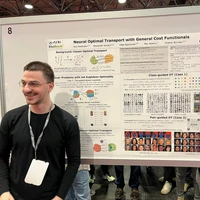
Neural Optimal Transport with General Cost Functionals
We introduce a novel neural network-based algorithm to compute optimal transport (OT) plans for general cost functionals. In contrast to common Euclidean costs, i.e., ell^1 or ell^2, such functionals provide more flexibility and allow using auxiliary information, such as class labels, to construct the required transport map. Existing methods for general costs are discrete and have limitations in practice, i.e. they do not provide an out-of-sample estimation. We address the challenge of designing a continuous OT approach for general costs that generalizes to new data points in high-dimensional spaces, such as images. Additionally, we provide the theoretical error analysis for our recovered transport plans. As an application, we construct a cost functional to map data distributions while preserving the class-wise structure.
vMAP: Vectorised Object Mapping for Neural Field SLAM
We present vMAP, an object-level dense SLAM system using neural field representations. Each object is represented by a small MLP, enabling efficient, watertight object modelling without the need for 3D priors. As an RGB-D camera browses a scene with no prior information, vMAP detects object instances on-the-fly, and dynamically adds them to its map. Specifically, thanks to the power of vectorised training, vMAP can optimise as many as 50 individual objects in a single scene, with an extremely efficient training speed of 5Hz map update. We experimentally demonstrate significantly improved scene-level and object-level reconstruction quality compared to prior neural field SLAM systems. Project page: https://kxhit.github.io/vMAP.

The Importance of Directional Feedback for LLM-based Optimizers
We study the potential of using large language models (LLMs) as an interactive optimizer for solving maximization problems in a text space using natural language and numerical feedback. Inspired by the classical optimization literature, we classify the natural language feedback into directional and non-directional, where the former is a generalization of the first-order feedback to the natural language space. We find that LLMs are especially capable of optimization when they are provided with {directional feedback}. Based on this insight, we design a new LLM-based optimizer that synthesizes directional feedback from the historical optimization trace to achieve reliable improvement over iterations. Empirically, we show our LLM-based optimizer is more stable and efficient in solving optimization problems, from maximizing mathematical functions to optimizing prompts for writing poems, compared with existing techniques.



Pre-trained knowledge elevates large language models beyond traditional chemical reaction optimizers
Modern optimization in experimental chemistry employs algorithmic search through black-box parameter spaces. Here we demonstrate that pre-trained knowledge in large language models (LLMs) fundamentally changes this paradigm. Using six fully enumerated categorical reaction datasets (768 - 5,684 experiments), we benchmark LLM-guided optimization (LLM-GO) against Bayesian optimization (BO) and random sampling. Frontier LLMs consistently match or exceed BO performance across five single-objective datasets, with advantages growing as parameter complexity increases and high-performing conditions become scarce (<5% of space). BO retains superiority only for explicit multi-objective trade-offs. To understand these contrasting behaviors, we introduce a topology-agnostic information theory framework quantifying sampling diversity throughout optimization campaigns. This analysis reveals that LLMs maintain systematically higher exploration entropy than BO across all datasets while achieving superior performance, with advantages most pronounced in solution-scarce parameter spaces where high-entropy exploration typically fails - suggesting that pre-trained domain knowledge enables more effective navigation of chemical parameter space rather than replacing structured exploration strategies. To enable transparent benchmarking and community validation, we release Iron Mind (https://gomes.andrew.cmu.edu/iron-mind), a no-code platform for side-by-side evaluation of human, algorithmic, and LLM optimization campaigns with public leaderboards and complete trajectories. Our findings establish that LLM-GO excels precisely where traditional methods struggle: complex categorical spaces requiring domain understanding rather than mathematical optimization.
CartoMark: a benchmark dataset for map pattern recognition and 1 map content retrieval with machine intelligence
Maps are fundamental medium to visualize and represent the real word in a simple and 16 philosophical way. The emergence of the 3rd wave information has made a proportion of maps are available to be generated ubiquitously, which would significantly enrich the dimensions and perspectives to understand the characteristics of the real world. However, a majority of map dataset have never been discovered, acquired and effectively used, and the map data used in many applications might not be completely fitted for the authentic demands of these applications. This challenge is emerged due to the lack of numerous well-labelled benchmark datasets for implementing the deep learning approaches into identifying complicated map content. Thus, we develop a large-scale benchmark dataset that includes well-labelled dataset for map text annotation recognition, map scene classification, map super-resolution reconstruction, and map style transferring. Furthermore, these well-labelled datasets would facilitate the state-of-the-art machine intelligence technologies to conduct map feature detection, map pattern recognition and map content retrieval. We hope our efforts would be useful for AI-enhanced cartographical applications.
Geometry-Aware Learning of Maps for Camera Localization
Maps are a key component in image-based camera localization and visual SLAM systems: they are used to establish geometric constraints between images, correct drift in relative pose estimation, and relocalize cameras after lost tracking. The exact definitions of maps, however, are often application-specific and hand-crafted for different scenarios (e.g. 3D landmarks, lines, planes, bags of visual words). We propose to represent maps as a deep neural net called MapNet, which enables learning a data-driven map representation. Unlike prior work on learning maps, MapNet exploits cheap and ubiquitous sensory inputs like visual odometry and GPS in addition to images and fuses them together for camera localization. Geometric constraints expressed by these inputs, which have traditionally been used in bundle adjustment or pose-graph optimization, are formulated as loss terms in MapNet training and also used during inference. In addition to directly improving localization accuracy, this allows us to update the MapNet (i.e., maps) in a self-supervised manner using additional unlabeled video sequences from the scene. We also propose a novel parameterization for camera rotation which is better suited for deep-learning based camera pose regression. Experimental results on both the indoor 7-Scenes dataset and the outdoor Oxford RobotCar dataset show significant performance improvement over prior work. The MapNet project webpage is https://goo.gl/mRB3Au.

MAPF-GPT: Imitation Learning for Multi-Agent Pathfinding at Scale
Multi-agent pathfinding (MAPF) is a challenging computational problem that typically requires to find collision-free paths for multiple agents in a shared environment. Solving MAPF optimally is NP-hard, yet efficient solutions are critical for numerous applications, including automated warehouses and transportation systems. Recently, learning-based approaches to MAPF have gained attention, particularly those leveraging deep reinforcement learning. Following current trends in machine learning, we have created a foundation model for the MAPF problems called MAPF-GPT. Using imitation learning, we have trained a policy on a set of pre-collected sub-optimal expert trajectories that can generate actions in conditions of partial observability without additional heuristics, reward functions, or communication with other agents. The resulting MAPF-GPT model demonstrates zero-shot learning abilities when solving the MAPF problem instances that were not present in the training dataset. We show that MAPF-GPT notably outperforms the current best-performing learnable-MAPF solvers on a diverse range of problem instances and is efficient in terms of computation (in the inference mode).

OptMATH: A Scalable Bidirectional Data Synthesis Framework for Optimization Modeling
Despite the rapid development of large language models (LLMs), a fundamental challenge persists: the lack of high-quality optimization modeling datasets hampers LLMs' robust modeling of practical optimization problems from natural language descriptions (NL). This data scarcity also contributes to the generalization difficulties experienced by learning-based methods. To address these challenges, we propose a scalable framework for synthesizing a high-quality dataset, named OptMATH. Starting from curated seed data with mathematical formulations (MF), this framework automatically generates problem data (PD) with controllable complexity. Then, a back-translation step is employed to obtain NL. To verify the correspondence between the NL and the PD, a forward modeling step followed by rejection sampling is used. The accepted pairs constitute the training part of OptMATH. Then a collection of rejected pairs is identified and further filtered. This collection serves as a new benchmark for optimization modeling, containing difficult instances whose lengths are much longer than these of NL4OPT and MAMO. Through extensive experiments, we demonstrate that models of various sizes (0.5B-32B parameters) trained on OptMATH achieve superior results on multiple modeling benchmarks, thereby validating the effectiveness and scalability of our approach. Our dataset is publicly available at https://github.com/AuroraLHL/OptMATH.
The Monge Gap: A Regularizer to Learn All Transport Maps
Optimal transport (OT) theory has been been used in machine learning to study and characterize maps that can push-forward efficiently a probability measure onto another. Recent works have drawn inspiration from Brenier's theorem, which states that when the ground cost is the squared-Euclidean distance, the ``best'' map to morph a continuous measure in P(Rd) into another must be the gradient of a convex function. To exploit that result, [Makkuva+ 2020, Korotin+2020] consider maps T=nabla f_theta, where f_theta is an input convex neural network (ICNN), as defined by Amos+2017, and fit theta with SGD using samples. Despite their mathematical elegance, fitting OT maps with ICNNs raises many challenges, due notably to the many constraints imposed on theta; the need to approximate the conjugate of f_theta; or the limitation that they only work for the squared-Euclidean cost. More generally, we question the relevance of using Brenier's result, which only applies to densities, to constrain the architecture of candidate maps fitted on samples. Motivated by these limitations, we propose a radically different approach to estimating OT maps: Given a cost c and a reference measure rho, we introduce a regularizer, the Monge gap M^c_{rho}(T) of a map T. That gap quantifies how far a map T deviates from the ideal properties we expect from a c-OT map. In practice, we drop all architecture requirements for T and simply minimize a distance (e.g., the Sinkhorn divergence) between Tsharpmu and nu, regularized by M^c_rho(T). We study M^c_{rho}, and show how our simple pipeline outperforms significantly other baselines in practice.
Sparse Multilevel Roadmaps for High-Dimensional Robot Motion Planning
Sparse roadmaps are important to compactly represent state spaces, to determine problems to be infeasible and to terminate in finite time. However, sparse roadmaps do not scale well to high-dimensional planning problems. In prior work, we showed improved planning performance on high-dimensional planning problems by using multilevel abstractions to simplify state spaces. In this work, we generalize sparse roadmaps to multilevel abstractions by developing a novel algorithm, the sparse multilevel roadmap planner (SMLR). To this end, we represent multilevel abstractions using the language of fiber bundles, and generalize sparse roadmap planners by using the concept of restriction sampling with visibility regions. We argue SMLR to be probabilistically complete and asymptotically near-optimal by inheritance from sparse roadmap planners. In evaluations, we outperform sparse roadmap planners on challenging planning problems, in particular problems which are high-dimensional, contain narrow passages or are infeasible. We thereby demonstrate sparse multilevel roadmaps as an efficient tool for feasible and infeasible high-dimensional planning problems.
Automated Optimization Modeling through Expert-Guided Large Language Model Reasoning
Optimization Modeling (OM) is essential for solving complex decision-making problems. However, the process remains time-consuming and error-prone, heavily relying on domain experts. While Large Language Models (LLMs) show promise in addressing these challenges through their natural language understanding and reasoning capabilities, current approaches face three critical limitations: high benchmark labeling error rates reaching up to 42%, narrow evaluation scope that only considers optimal values, and computational inefficiency due to heavy reliance on multi-agent systems or model fine-tuning. In this work, we first enhance existing datasets through systematic error correction and more comprehensive annotation. Additionally, we introduce LogiOR, a new optimization modeling benchmark from the logistics domain, containing more complex problems with standardized annotations. Furthermore, we present ORThought, a novel framework that leverages expert-level optimization modeling principles through chain-of-thought reasoning to automate the OM process. Through extensive empirical evaluation, we demonstrate that ORThought outperforms existing approaches, including multi-agent frameworks, with particularly significant advantages on complex optimization problems. Finally, we provide a systematic analysis of our method, identifying critical success factors and failure modes, providing valuable insights for future research on LLM-based optimization modeling.
RGB-Only Supervised Camera Parameter Optimization in Dynamic Scenes
Although COLMAP has long remained the predominant method for camera parameter optimization in static scenes, it is constrained by its lengthy runtime and reliance on ground truth (GT) motion masks for application to dynamic scenes. Many efforts attempted to improve it by incorporating more priors as supervision such as GT focal length, motion masks, 3D point clouds, camera poses, and metric depth, which, however, are typically unavailable in casually captured RGB videos. In this paper, we propose a novel method for more accurate and efficient camera parameter optimization in dynamic scenes solely supervised by a single RGB video. Our method consists of three key components: (1) Patch-wise Tracking Filters, to establish robust and maximally sparse hinge-like relations across the RGB video. (2) Outlier-aware Joint Optimization, for efficient camera parameter optimization by adaptive down-weighting of moving outliers, without reliance on motion priors. (3) A Two-stage Optimization Strategy, to enhance stability and optimization speed by a trade-off between the Softplus limits and convex minima in losses. We visually and numerically evaluate our camera estimates. To further validate accuracy, we feed the camera estimates into a 4D reconstruction method and assess the resulting 3D scenes, and rendered 2D RGB and depth maps. We perform experiments on 4 real-world datasets (NeRF-DS, DAVIS, iPhone, and TUM-dynamics) and 1 synthetic dataset (MPI-Sintel), demonstrating that our method estimates camera parameters more efficiently and accurately with a single RGB video as the only supervision.

Large Language Models as Optimizers
Optimization is ubiquitous. While derivative-based algorithms have been powerful tools for various problems, the absence of gradient imposes challenges on many real-world applications. In this work, we propose Optimization by PROmpting (OPRO), a simple and effective approach to leverage large language models (LLMs) as optimizers, where the optimization task is described in natural language. In each optimization step, the LLM generates new solutions from the prompt that contains previously generated solutions with their values, then the new solutions are evaluated and added to the prompt for the next optimization step. We first showcase OPRO on linear regression and traveling salesman problems, then move on to prompt optimization where the goal is to find instructions that maximize the task accuracy. With a variety of LLMs, we demonstrate that the best prompts optimized by OPRO outperform human-designed prompts by up to 8% on GSM8K, and by up to 50% on Big-Bench Hard tasks.




μLO: Compute-Efficient Meta-Generalization of Learned Optimizers
Learned optimizers (LOs) can significantly reduce the wall-clock training time of neural networks, substantially reducing training costs. However, they often suffer from poor meta-generalization, especially when training networks larger than those seen during meta-training. To address this, we use the recently proposed Maximal Update Parametrization (muP), which allows zero-shot generalization of optimizer hyperparameters from smaller to larger models. We extend muP theory to learned optimizers, treating the meta-training problem as finding the learned optimizer under muP. Our evaluation shows that LOs meta-trained with muP substantially improve meta-generalization as compared to LOs trained under standard parametrization (SP). Notably, when applied to large-width models, our best muLO, trained for 103 GPU-hours, matches or exceeds the performance of VeLO, the largest publicly available learned optimizer, meta-trained with 4000 TPU-months of compute. Moreover, muLOs demonstrate better generalization than their SP counterparts to deeper networks and to much longer training horizons (25 times longer) than those seen during meta-training.




Low-Switching Policy Gradient with Exploration via Online Sensitivity Sampling
Policy optimization methods are powerful algorithms in Reinforcement Learning (RL) for their flexibility to deal with policy parameterization and ability to handle model misspecification. However, these methods usually suffer from slow convergence rates and poor sample complexity. Hence it is important to design provably sample efficient algorithms for policy optimization. Yet, recent advances for this problems have only been successful in tabular and linear setting, whose benign structures cannot be generalized to non-linearly parameterized policies. In this paper, we address this problem by leveraging recent advances in value-based algorithms, including bounded eluder-dimension and online sensitivity sampling, to design a low-switching sample-efficient policy optimization algorithm, LPO, with general non-linear function approximation. We show that, our algorithm obtains an varepsilon-optimal policy with only O(text{poly(d)}{varepsilon^3}) samples, where varepsilon is the suboptimality gap and d is a complexity measure of the function class approximating the policy. This drastically improves previously best-known sample bound for policy optimization algorithms, O(text{poly(d)}{varepsilon^8}). Moreover, we empirically test our theory with deep neural nets to show the benefits of the theoretical inspiration.

Accelerated Infeasibility Detection of Constrained Optimization and Fixed-Point Iterations
As first-order optimization methods become the method of choice for solving large-scale optimization problems, optimization solvers based on first-order algorithms are being built. Such general-purpose solvers must robustly detect infeasible or misspecified problem instances, but the computational complexity of first-order methods for doing so has yet to be formally studied. In this work, we characterize the optimal accelerated rate of infeasibility detection. We show that the standard fixed-point iteration achieves a O(1/k^2) and O(1/k) rates, respectively, on the normalized iterates and the fixed-point residual converging to the infimal displacement vector, while the accelerated fixed-point iteration achieves O(1/k^2) and mathcal{O}(1/k^2) rates. We then provide a matching complexity lower bound to establish that Theta(1/k^2) is indeed the optimal accelerated rate.
Motion Planning by Learning the Solution Manifold in Trajectory Optimization
The objective function used in trajectory optimization is often non-convex and can have an infinite set of local optima. In such cases, there are diverse solutions to perform a given task. Although there are a few methods to find multiple solutions for motion planning, they are limited to generating a finite set of solutions. To address this issue, we presents an optimization method that learns an infinite set of solutions in trajectory optimization. In our framework, diverse solutions are obtained by learning latent representations of solutions. Our approach can be interpreted as training a deep generative model of collision-free trajectories for motion planning. The experimental results indicate that the trained model represents an infinite set of homotopic solutions for motion planning problems.
If beam search is the answer, what was the question?
Quite surprisingly, exact maximum a posteriori (MAP) decoding of neural language generators frequently leads to low-quality results. Rather, most state-of-the-art results on language generation tasks are attained using beam search despite its overwhelmingly high search error rate. This implies that the MAP objective alone does not express the properties we desire in text, which merits the question: if beam search is the answer, what was the question? We frame beam search as the exact solution to a different decoding objective in order to gain insights into why high probability under a model alone may not indicate adequacy. We find that beam search enforces uniform information density in text, a property motivated by cognitive science. We suggest a set of decoding objectives that explicitly enforce this property and find that exact decoding with these objectives alleviates the problems encountered when decoding poorly calibrated language generation models. Additionally, we analyze the text produced using various decoding strategies and see that, in our neural machine translation experiments, the extent to which this property is adhered to strongly correlates with BLEU.

Scattered Forest Search: Smarter Code Space Exploration with LLMs
We propose a novel approach to scaling LLM inference for code generation. We frame code generation as a black box optimization problem within the code space, and employ optimization-inspired techniques to enhance exploration. Specifically, we introduce Scattered Forest Search to enhance solution diversity while searching for solutions. Our theoretical analysis illustrates how these methods avoid local optima during optimization. Extensive experiments on HumanEval, MBPP, APPS, CodeContests, and Leetcode reveal significant performance improvements. For instance, our method achieves a pass@1 rate of 67.1% on HumanEval+ and 87.2% on HumanEval with GPT-3.5, marking improvements of 8.6% and 4.3% over the state-of-the-art, while also halving the iterations needed to find the correct solution. Furthermore, our method scales more efficiently than existing search techniques, including tree search, line search, and repeated sampling.
Advancing Learnable Multi-Agent Pathfinding Solvers with Active Fine-Tuning
Multi-agent pathfinding (MAPF) is a common abstraction of multi-robot trajectory planning problems, where multiple homogeneous robots simultaneously move in the shared environment. While solving MAPF optimally has been proven to be NP-hard, scalable, and efficient, solvers are vital for real-world applications like logistics, search-and-rescue, etc. To this end, decentralized suboptimal MAPF solvers that leverage machine learning have come on stage. Building on the success of the recently introduced MAPF-GPT, a pure imitation learning solver, we introduce MAPF-GPT-DDG. This novel approach effectively fine-tunes the pre-trained MAPF model using centralized expert data. Leveraging a novel delta-data generation mechanism, MAPF-GPT-DDG accelerates training while significantly improving performance at test time. Our experiments demonstrate that MAPF-GPT-DDG surpasses all existing learning-based MAPF solvers, including the original MAPF-GPT, regarding solution quality across many testing scenarios. Remarkably, it can work with MAPF instances involving up to 1 million agents in a single environment, setting a new milestone for scalability in MAPF domains.
Optimizing NOTEARS Objectives via Topological Swaps
Recently, an intriguing class of non-convex optimization problems has emerged in the context of learning directed acyclic graphs (DAGs). These problems involve minimizing a given loss or score function, subject to a non-convex continuous constraint that penalizes the presence of cycles in a graph. In this work, we delve into the optimization challenges associated with this class of non-convex programs. To address these challenges, we propose a bi-level algorithm that leverages the non-convex constraint in a novel way. The outer level of the algorithm optimizes over topological orders by iteratively swapping pairs of nodes within the topological order of a DAG. A key innovation of our approach is the development of an effective method for generating a set of candidate swapping pairs for each iteration. At the inner level, given a topological order, we utilize off-the-shelf solvers that can handle linear constraints. The key advantage of our proposed algorithm is that it is guaranteed to find a local minimum or a KKT point under weaker conditions compared to previous work and finds solutions with lower scores. Extensive experiments demonstrate that our method outperforms state-of-the-art approaches in terms of achieving a better score. Additionally, our method can also be used as a post-processing algorithm to significantly improve the score of other algorithms. Code implementing the proposed method is available at https://github.com/duntrain/topo.
Tackling Prevalent Conditions in Unsupervised Combinatorial Optimization: Cardinality, Minimum, Covering, and More
Combinatorial optimization (CO) is naturally discrete, making machine learning based on differentiable optimization inapplicable. Karalias & Loukas (2020) adapted the probabilistic method to incorporate CO into differentiable optimization. Their work ignited the research on unsupervised learning for CO, composed of two main components: probabilistic objectives and derandomization. However, each component confronts unique challenges. First, deriving objectives under various conditions (e.g., cardinality constraints and minimum) is nontrivial. Second, the derandomization process is underexplored, and the existing derandomization methods are either random sampling or naive rounding. In this work, we aim to tackle prevalent (i.e., commonly involved) conditions in unsupervised CO. First, we concretize the targets for objective construction and derandomization with theoretical justification. Then, for various conditions commonly involved in different CO problems, we derive nontrivial objectives and derandomization to meet the targets. Finally, we apply the derivations to various CO problems. Via extensive experiments on synthetic and real-world graphs, we validate the correctness of our derivations and show our empirical superiority w.r.t. both optimization quality and speed.

Can Large Vision Language Models Read Maps Like a Human?
In this paper, we introduce MapBench-the first dataset specifically designed for human-readable, pixel-based map-based outdoor navigation, curated from complex path finding scenarios. MapBench comprises over 1600 pixel space map path finding problems from 100 diverse maps. In MapBench, LVLMs generate language-based navigation instructions given a map image and a query with beginning and end landmarks. For each map, MapBench provides Map Space Scene Graph (MSSG) as an indexing data structure to convert between natural language and evaluate LVLM-generated results. We demonstrate that MapBench significantly challenges state-of-the-art LVLMs both zero-shot prompting and a Chain-of-Thought (CoT) augmented reasoning framework that decomposes map navigation into sequential cognitive processes. Our evaluation of both open-source and closed-source LVLMs underscores the substantial difficulty posed by MapBench, revealing critical limitations in their spatial reasoning and structured decision-making capabilities. We release all the code and dataset in https://github.com/taco-group/MapBench.



MAP-Elites with Descriptor-Conditioned Gradients and Archive Distillation into a Single Policy
Quality-Diversity algorithms, such as MAP-Elites, are a branch of Evolutionary Computation generating collections of diverse and high-performing solutions, that have been successfully applied to a variety of domains and particularly in evolutionary robotics. However, MAP-Elites performs a divergent search based on random mutations originating from Genetic Algorithms, and thus, is limited to evolving populations of low-dimensional solutions. PGA-MAP-Elites overcomes this limitation by integrating a gradient-based variation operator inspired by Deep Reinforcement Learning which enables the evolution of large neural networks. Although high-performing in many environments, PGA-MAP-Elites fails on several tasks where the convergent search of the gradient-based operator does not direct mutations towards archive-improving solutions. In this work, we present two contributions: (1) we enhance the Policy Gradient variation operator with a descriptor-conditioned critic that improves the archive across the entire descriptor space, (2) we exploit the actor-critic training to learn a descriptor-conditioned policy at no additional cost, distilling the knowledge of the archive into one single versatile policy that can execute the entire range of behaviors contained in the archive. Our algorithm, DCG-MAP-Elites improves the QD score over PGA-MAP-Elites by 82% on average, on a set of challenging locomotion tasks.
Tutorial on amortized optimization
Optimization is a ubiquitous modeling tool and is often deployed in settings which repeatedly solve similar instances of the same problem. Amortized optimization methods use learning to predict the solutions to problems in these settings, exploiting the shared structure between similar problem instances. These methods have been crucial in variational inference and reinforcement learning and are capable of solving optimization problems many orders of magnitudes times faster than traditional optimization methods that do not use amortization. This tutorial presents an introduction to the amortized optimization foundations behind these advancements and overviews their applications in variational inference, sparse coding, gradient-based meta-learning, control, reinforcement learning, convex optimization, optimal transport, and deep equilibrium networks. The source code for this tutorial is available at https://github.com/facebookresearch/amortized-optimization-tutorial.
Generative Modeling with Optimal Transport Maps
With the discovery of Wasserstein GANs, Optimal Transport (OT) has become a powerful tool for large-scale generative modeling tasks. In these tasks, OT cost is typically used as the loss for training GANs. In contrast to this approach, we show that the OT map itself can be used as a generative model, providing comparable performance. Previous analogous approaches consider OT maps as generative models only in the latent spaces due to their poor performance in the original high-dimensional ambient space. In contrast, we apply OT maps directly in the ambient space, e.g., a space of high-dimensional images. First, we derive a min-max optimization algorithm to efficiently compute OT maps for the quadratic cost (Wasserstein-2 distance). Next, we extend the approach to the case when the input and output distributions are located in the spaces of different dimensions and derive error bounds for the computed OT map. We evaluate the algorithm on image generation and unpaired image restoration tasks. In particular, we consider denoising, colorization, and inpainting, where the optimality of the restoration map is a desired attribute, since the output (restored) image is expected to be close to the input (degraded) one.

Practical tradeoffs between memory, compute, and performance in learned optimizers
Optimization plays a costly and crucial role in developing machine learning systems. In learned optimizers, the few hyperparameters of commonly used hand-designed optimizers, e.g. Adam or SGD, are replaced with flexible parametric functions. The parameters of these functions are then optimized so that the resulting learned optimizer minimizes a target loss on a chosen class of models. Learned optimizers can both reduce the number of required training steps and improve the final test loss. However, they can be expensive to train, and once trained can be expensive to use due to computational and memory overhead for the optimizer itself. In this work, we identify and quantify the design features governing the memory, compute, and performance trade-offs for many learned and hand-designed optimizers. We further leverage our analysis to construct a learned optimizer that is both faster and more memory efficient than previous work. Our model and training code are open source.

Bayesian Optimization for Selecting Efficient Machine Learning Models
The performance of many machine learning models depends on their hyper-parameter settings. Bayesian Optimization has become a successful tool for hyper-parameter optimization of machine learning algorithms, which aims to identify optimal hyper-parameters during an iterative sequential process. However, most of the Bayesian Optimization algorithms are designed to select models for effectiveness only and ignore the important issue of model training efficiency. Given that both model effectiveness and training time are important for real-world applications, models selected for effectiveness may not meet the strict training time requirements necessary to deploy in a production environment. In this work, we present a unified Bayesian Optimization framework for jointly optimizing models for both prediction effectiveness and training efficiency. We propose an objective that captures the tradeoff between these two metrics and demonstrate how we can jointly optimize them in a principled Bayesian Optimization framework. Experiments on model selection for recommendation tasks indicate models selected this way significantly improves model training efficiency while maintaining strong effectiveness as compared to state-of-the-art Bayesian Optimization algorithms.


Mirror Sinkhorn: Fast Online Optimization on Transport Polytopes
Optimal transport is an important tool in machine learning, allowing to capture geometric properties of the data through a linear program on transport polytopes. We present a single-loop optimization algorithm for minimizing general convex objectives on these domains, utilizing the principles of Sinkhorn matrix scaling and mirror descent. The proposed algorithm is robust to noise, and can be used in an online setting. We provide theoretical guarantees for convex objectives and experimental results showcasing it effectiveness on both synthetic and real-world data.
A Survey on the Optimization of Large Language Model-based Agents
With the rapid development of Large Language Models (LLMs), LLM-based agents have been widely adopted in various fields, becoming essential for autonomous decision-making and interactive tasks. However, current work typically relies on prompt design or fine-tuning strategies applied to vanilla LLMs, which often leads to limited effectiveness or suboptimal performance in complex agent-related environments. Although LLM optimization techniques can improve model performance across many general tasks, they lack specialized optimization towards critical agent functionalities such as long-term planning, dynamic environmental interaction, and complex decision-making. Although numerous recent studies have explored various strategies to optimize LLM-based agents for complex agent tasks, a systematic review summarizing and comparing these methods from a holistic perspective is still lacking. In this survey, we provide a comprehensive review of LLM-based agent optimization approaches, categorizing them into parameter-driven and parameter-free methods. We first focus on parameter-driven optimization, covering fine-tuning-based optimization, reinforcement learning-based optimization, and hybrid strategies, analyzing key aspects such as trajectory data construction, fine-tuning techniques, reward function design, and optimization algorithms. Additionally, we briefly discuss parameter-free strategies that optimize agent behavior through prompt engineering and external knowledge retrieval. Finally, we summarize the datasets and benchmarks used for evaluation and tuning, review key applications of LLM-based agents, and discuss major challenges and promising future directions. Our repository for related references is available at https://github.com/YoungDubbyDu/LLM-Agent-Optimization.

Relaxing the Additivity Constraints in Decentralized No-Regret High-Dimensional Bayesian Optimization
Bayesian Optimization (BO) is typically used to optimize an unknown function f that is noisy and costly to evaluate, by exploiting an acquisition function that must be maximized at each optimization step. Even if provably asymptotically optimal BO algorithms are efficient at optimizing low-dimensional functions, scaling them to high-dimensional spaces remains an open problem, often tackled by assuming an additive structure for f. By doing so, BO algorithms typically introduce additional restrictive assumptions on the additive structure that reduce their applicability domain. This paper contains two main contributions: (i) we relax the restrictive assumptions on the additive structure of f without weakening the maximization guarantees of the acquisition function, and (ii) we address the over-exploration problem for decentralized BO algorithms. To these ends, we propose DuMBO, an asymptotically optimal decentralized BO algorithm that achieves very competitive performance against state-of-the-art BO algorithms, especially when the additive structure of f comprises high-dimensional factors.
Accelerating RL for LLM Reasoning with Optimal Advantage Regression
Reinforcement learning (RL) has emerged as a powerful tool for fine-tuning large language models (LLMs) to improve complex reasoning abilities. However, state-of-the-art policy optimization methods often suffer from high computational overhead and memory consumption, primarily due to the need for multiple generations per prompt and the reliance on critic networks or advantage estimates of the current policy. In this paper, we propose A*-PO, a novel two-stage policy optimization framework that directly approximates the optimal advantage function and enables efficient training of LLMs for reasoning tasks. In the first stage, we leverage offline sampling from a reference policy to estimate the optimal value function V*, eliminating the need for costly online value estimation. In the second stage, we perform on-policy updates using a simple least-squares regression loss with only a single generation per prompt. Theoretically, we establish performance guarantees and prove that the KL-regularized RL objective can be optimized without requiring complex exploration strategies. Empirically, A*-PO achieves competitive performance across a wide range of mathematical reasoning benchmarks, while reducing training time by up to 2times and peak memory usage by over 30% compared to PPO, GRPO, and REBEL. Implementation of A*-PO can be found at https://github.com/ZhaolinGao/A-PO.



Generative AI in Map-Making: A Technical Exploration and Its Implications for Cartographers
Traditional map-making relies heavily on Geographic Information Systems (GIS), requiring domain expertise and being time-consuming, especially for repetitive tasks. Recent advances in generative AI (GenAI), particularly image diffusion models, offer new opportunities for automating and democratizing the map-making process. However, these models struggle with accurate map creation due to limited control over spatial composition and semantic layout. To address this, we integrate vector data to guide map generation in different styles, specified by the textual prompts. Our model is the first to generate accurate maps in controlled styles, and we have integrated it into a web application to improve its usability and accessibility. We conducted a user study with professional cartographers to assess the fidelity of generated maps, the usability of the web application, and the implications of ever-emerging GenAI in map-making. The findings have suggested the potential of our developed application and, more generally, the GenAI models in helping both non-expert users and professionals in creating maps more efficiently. We have also outlined further technical improvements and emphasized the new role of cartographers to advance the paradigm of AI-assisted map-making. The code and pre-trained models are available at https://github.com/claudaff/generative-ai-mapmaking/.
Generalizable Heuristic Generation Through Large Language Models with Meta-Optimization
Heuristic design with large language models (LLMs) has emerged as a promising approach for tackling combinatorial optimization problems (COPs). However, existing approaches often rely on manually predefined evolutionary computation (EC) optimizers and single-task training schemes, which may constrain the exploration of diverse heuristic algorithms and hinder the generalization of the resulting heuristics. To address these issues, we propose Meta-Optimization of Heuristics (MoH), a novel framework that operates at the optimizer level, discovering effective optimizers through the principle of meta-learning. Specifically, MoH leverages LLMs to iteratively refine a meta-optimizer that autonomously constructs diverse optimizers through (self-)invocation, thereby eliminating the reliance on a predefined EC optimizer. These constructed optimizers subsequently evolve heuristics for downstream tasks, enabling broader heuristic exploration. Moreover, MoH employs a multi-task training scheme to promote its generalization capability. Experiments on classic COPs demonstrate that MoH constructs an effective and interpretable meta-optimizer, achieving state-of-the-art performance across various downstream tasks, particularly in cross-size settings.
Large Language Models for Combinatorial Optimization: A Systematic Review
This systematic review explores the application of Large Language Models (LLMs) in Combinatorial Optimization (CO). We report our findings using the Preferred Reporting Items for Systematic Reviews and Meta-Analyses (PRISMA) guidelines. We conduct a literature search via Scopus and Google Scholar, examining over 2,000 publications. We assess publications against four inclusion and four exclusion criteria related to their language, research focus, publication year, and type. Eventually, we select 103 studies. We classify these studies into semantic categories and topics to provide a comprehensive overview of the field, including the tasks performed by LLMs, the architectures of LLMs, the existing datasets specifically designed for evaluating LLMs in CO, and the field of application. Finally, we identify future directions for leveraging LLMs in this field.
GridRoute: A Benchmark for LLM-Based Route Planning with Cardinal Movement in Grid Environments
Recent advancements in Large Language Models (LLMs) have demonstrated their potential in planning and reasoning tasks, offering a flexible alternative to classical pathfinding algorithms. However, most existing studies focus on LLMs' independent reasoning capabilities and overlook the potential synergy between LLMs and traditional algorithms. To fill this gap, we propose a comprehensive evaluation benchmark GridRoute to assess how LLMs can take advantage of traditional algorithms. We also propose a novel hybrid prompting technique called Algorithm of Thought (AoT), which introduces traditional algorithms' guidance into prompting. Our benchmark evaluates six LLMs ranging from 7B to 72B parameters across various map sizes, assessing their performance in correctness, optimality, and efficiency in grid environments with varying sizes. Our results show that AoT significantly boosts performance across all model sizes, particularly in larger or more complex environments, suggesting a promising approach to addressing path planning challenges. Our code is open-sourced at https://github.com/LinChance/GridRoute.

EquivaMap: Leveraging LLMs for Automatic Equivalence Checking of Optimization Formulations
A fundamental problem in combinatorial optimization is identifying equivalent formulations, which can lead to more efficient solution strategies and deeper insights into a problem's computational complexity. The need to automatically identify equivalence between problem formulations has grown as optimization copilots--systems that generate problem formulations from natural language descriptions--have proliferated. However, existing approaches to checking formulation equivalence lack grounding, relying on simple heuristics which are insufficient for rigorous validation. Inspired by Karp reductions, in this work we introduce quasi-Karp equivalence, a formal criterion for determining when two optimization formulations are equivalent based on the existence of a mapping between their decision variables. We propose EquivaMap, a framework that leverages large language models to automatically discover such mappings, enabling scalable and reliable equivalence verification. To evaluate our approach, we construct the first open-source dataset of equivalent optimization formulations, generated by applying transformations such as adding slack variables or valid inequalities to existing formulations. Empirically, EquivaMap significantly outperforms existing methods, achieving substantial improvements in correctly identifying formulation equivalence.

Learn to Follow: Decentralized Lifelong Multi-agent Pathfinding via Planning and Learning
Multi-agent Pathfinding (MAPF) problem generally asks to find a set of conflict-free paths for a set of agents confined to a graph and is typically solved in a centralized fashion. Conversely, in this work, we investigate the decentralized MAPF setting, when the central controller that posses all the information on the agents' locations and goals is absent and the agents have to sequientially decide the actions on their own without having access to a full state of the environment. We focus on the practically important lifelong variant of MAPF, which involves continuously assigning new goals to the agents upon arrival to the previous ones. To address this complex problem, we propose a method that integrates two complementary approaches: planning with heuristic search and reinforcement learning through policy optimization. Planning is utilized to construct and re-plan individual paths. We enhance our planning algorithm with a dedicated technique tailored to avoid congestion and increase the throughput of the system. We employ reinforcement learning to discover the collision avoidance policies that effectively guide the agents along the paths. The policy is implemented as a neural network and is effectively trained without any reward-shaping or external guidance. We evaluate our method on a wide range of setups comparing it to the state-of-the-art solvers. The results show that our method consistently outperforms the learnable competitors, showing higher throughput and better ability to generalize to the maps that were unseen at the training stage. Moreover our solver outperforms a rule-based one in terms of throughput and is an order of magnitude faster than a state-of-the-art search-based solver.
Traffic Flow Optimisation for Lifelong Multi-Agent Path Finding
Multi-Agent Path Finding (MAPF) is a fundamental problem in robotics that asks us to compute collision-free paths for a team of agents, all moving across a shared map. Although many works appear on this topic, all current algorithms struggle as the number of agents grows. The principal reason is that existing approaches typically plan free-flow optimal paths, which creates congestion. To tackle this issue, we propose a new approach for MAPF where agents are guided to their destination by following congestion-avoiding paths. We evaluate the idea in two large-scale settings: one-shot MAPF, where each agent has a single destination, and lifelong MAPF, where agents are continuously assigned new destinations. Empirically, we report large improvements in solution quality for one-short MAPF and in overall throughput for lifelong MAPF.
metaTextGrad: Automatically optimizing language model optimizers
Large language models (LLMs) are increasingly used in learning algorithms, evaluations, and optimization tasks. Recent studies have shown that using LLM-based optimizers to automatically optimize model prompts, demonstrations, predictions themselves, or other components can significantly enhance the performance of AI systems, as demonstrated by frameworks such as DSPy and TextGrad. However, optimizers built on language models themselves are usually designed by humans with manual design choices; optimizers themselves are not optimized. Moreover, these optimizers are general purpose by design, to be useful to a broad audience, and are not tailored for specific tasks. To address these challenges, we propose metaTextGrad, which focuses on designing a meta-optimizer to further enhance existing optimizers and align them to be good optimizers for a given task. Our approach consists of two key components: a meta prompt optimizer and a meta structure optimizer. The combination of these two significantly improves performance across multiple benchmarks, achieving an average absolute performance improvement of up to 6% compared to the best baseline.

An Analysis of Hyper-Parameter Optimization Methods for Retrieval Augmented Generation
Finding the optimal Retrieval-Augmented Generation (RAG) configuration for a given use case can be complex and expensive. Motivated by this challenge, frameworks for RAG hyper-parameter optimization (HPO) have recently emerged, yet their effectiveness has not been rigorously benchmarked. To address this gap, we present a comprehensive study involving 5 HPO algorithms over 5 datasets from diverse domains, including a new one collected for this work on real-world product documentation. Our study explores the largest HPO search space considered to date, with two optimized evaluation metrics. Analysis of the results shows that RAG HPO can be done efficiently, either greedily or with iterative random search, and that it significantly boosts RAG performance for all datasets. For greedy HPO approaches, we show that optimizing models first is preferable to the prevalent practice of optimizing sequentially according to the RAG pipeline order.

MapGPT: Map-Guided Prompting for Unified Vision-and-Language Navigation
Embodied agents equipped with GPT as their brain have exhibited extraordinary thinking and decision-making abilities across various tasks. However, existing zero-shot agents for vision-and-language navigation (VLN) only prompt the GPT to handle excessive environmental information and select potential locations within localized environments, without constructing an effective ''global-view'' (e.g., a commonly-used map) for the agent to understand the overall environment. In this work, we present a novel map-guided GPT-based path-planning agent, dubbed MapGPT, for the zero-shot VLN task. Specifically, we convert a topological map constructed online into prompts to encourage map-guided global exploration, and require the agent to explicitly output and update multi-step path planning to avoid getting stuck in local exploration. Extensive experiments demonstrate that our MapGPT is effective, achieving impressive performance on both the R2R and REVERIE datasets (38.8% and 28.4% success rate, respectively) and showcasing the newly emerged global thinking and path planning capabilities of the GPT model. Unlike previous VLN agents, which require separate parameters fine-tuning or specific prompt design to accommodate various instruction styles across different datasets, our MapGPT is more unified as it can adapt to different instruction styles seamlessly, which is the first of its kind in this field.

OptiBench Meets ReSocratic: Measure and Improve LLMs for Optimization Modeling
Large language models (LLMs) have exhibited their problem-solving abilities in mathematical reasoning. Solving realistic optimization (OPT) problems in application scenarios requires advanced and applied mathematics ability. However, current OPT benchmarks that merely solve linear programming are far from complex realistic situations. In this work, we propose OptiBench, a benchmark for End-to-end optimization problem-solving with human-readable inputs and outputs. OptiBench contains rich optimization problems, including linear and nonlinear programming with or without tabular data, which can comprehensively evaluate LLMs' solving ability. In our benchmark, LLMs are required to call a code solver to provide precise numerical answers. Furthermore, to alleviate the data scarcity for optimization problems, and to bridge the gap between open-source LLMs on a small scale (e.g., Llama-3-8b) and closed-source LLMs (e.g., GPT-4), we further propose a data synthesis method namely ReSocratic. Unlike general data synthesis methods that proceed from questions to answers, \ReSocratic first incrementally synthesizes formatted optimization demonstration with mathematical formulations step by step and then back-translates the generated demonstrations into questions. Based on this, we synthesize the ReSocratic-29k dataset. We further conduct supervised fine-tuning with ReSocratic-29k on multiple open-source models. Experimental results show that ReSocratic-29k significantly improves the performance of open-source models.


Minimax estimation of discontinuous optimal transport maps: The semi-discrete case
We consider the problem of estimating the optimal transport map between two probability distributions, P and Q in mathbb R^d, on the basis of i.i.d. samples. All existing statistical analyses of this problem require the assumption that the transport map is Lipschitz, a strong requirement that, in particular, excludes any examples where the transport map is discontinuous. As a first step towards developing estimation procedures for discontinuous maps, we consider the important special case where the data distribution Q is a discrete measure supported on a finite number of points in mathbb R^d. We study a computationally efficient estimator initially proposed by Pooladian and Niles-Weed (2021), based on entropic optimal transport, and show in the semi-discrete setting that it converges at the minimax-optimal rate n^{-1/2}, independent of dimension. Other standard map estimation techniques both lack finite-sample guarantees in this setting and provably suffer from the curse of dimensionality. We confirm these results in numerical experiments, and provide experiments for other settings, not covered by our theory, which indicate that the entropic estimator is a promising methodology for other discontinuous transport map estimation problems.
Benchmarking Optimizers for Large Language Model Pretraining
The recent development of Large Language Models (LLMs) has been accompanied by an effervescence of novel ideas and methods to better optimize the loss of deep learning models. Claims from those methods are myriad: from faster convergence to removing reliance on certain hyperparameters. However, the diverse experimental protocols used to validate these claims make direct comparisons between methods challenging. This study presents a comprehensive evaluation of recent optimization techniques across standardized LLM pretraining scenarios, systematically varying model size, batch size, and training duration. Through careful tuning of each method, we provide guidance to practitioners on which optimizer is best suited for each scenario. For researchers, our work highlights promising directions for future optimization research. Finally, by releasing our code and making all experiments fully reproducible, we hope our efforts can help the development and rigorous benchmarking of future methods.



SNAP: Self-Supervised Neural Maps for Visual Positioning and Semantic Understanding
Semantic 2D maps are commonly used by humans and machines for navigation purposes, whether it's walking or driving. However, these maps have limitations: they lack detail, often contain inaccuracies, and are difficult to create and maintain, especially in an automated fashion. Can we use raw imagery to automatically create better maps that can be easily interpreted by both humans and machines? We introduce SNAP, a deep network that learns rich neural 2D maps from ground-level and overhead images. We train our model to align neural maps estimated from different inputs, supervised only with camera poses over tens of millions of StreetView images. SNAP can resolve the location of challenging image queries beyond the reach of traditional methods, outperforming the state of the art in localization by a large margin. Moreover, our neural maps encode not only geometry and appearance but also high-level semantics, discovered without explicit supervision. This enables effective pre-training for data-efficient semantic scene understanding, with the potential to unlock cost-efficient creation of more detailed maps.
Cutting Slack: Quantum Optimization with Slack-Free Methods for Combinatorial Benchmarks
Constraint handling remains a key bottleneck in quantum combinatorial optimization. While slack-variable-based encodings are straightforward, they significantly increase qubit counts and circuit depth, challenging the scalability of quantum solvers. In this work, we investigate a suite of Lagrangian-based optimization techniques including dual ascent, bundle methods, cutting plane approaches, and augmented Lagrangian formulations for solving constrained combinatorial problems on quantum simulators and hardware. Our framework is applied to three representative NP-hard problems: the Travelling Salesman Problem (TSP), the Multi-Dimensional Knapsack Problem (MDKP), and the Maximum Independent Set (MIS). We demonstrate that MDKP and TSP, with their inequality-based or degree-constrained structures, allow for slack-free reformulations, leading to significant qubit savings without compromising performance. In contrast, MIS does not inherently benefit from slack elimination but still gains in feasibility and objective quality from principled Lagrangian updates. We benchmark these methods across classically hard instances, analyzing trade-offs in qubit usage, feasibility, and optimality gaps. Our results highlight the flexibility of Lagrangian formulations as a scalable alternative to naive QUBO penalization, even when qubit savings are not always achievable. This work provides practical insights for deploying constraint-aware quantum optimization pipelines, with applications in logistics, network design, and resource allocation.

VectorMapNet: End-to-end Vectorized HD Map Learning
Autonomous driving systems require High-Definition (HD) semantic maps to navigate around urban roads. Existing solutions approach the semantic mapping problem by offline manual annotation, which suffers from serious scalability issues. Recent learning-based methods produce dense rasterized segmentation predictions to construct maps. However, these predictions do not include instance information of individual map elements and require heuristic post-processing to obtain vectorized maps. To tackle these challenges, we introduce an end-to-end vectorized HD map learning pipeline, termed VectorMapNet. VectorMapNet takes onboard sensor observations and predicts a sparse set of polylines in the bird's-eye view. This pipeline can explicitly model the spatial relation between map elements and generate vectorized maps that are friendly to downstream autonomous driving tasks. Extensive experiments show that VectorMapNet achieve strong map learning performance on both nuScenes and Argoverse2 dataset, surpassing previous state-of-the-art methods by 14.2 mAP and 14.6mAP. Qualitatively, VectorMapNet is capable of generating comprehensive maps and capturing fine-grained details of road geometry. To the best of our knowledge, VectorMapNet is the first work designed towards end-to-end vectorized map learning from onboard observations. Our project website is available at https://tsinghua-mars-lab.github.io/vectormapnet/.
Unified Software Design Patterns for Simulated Annealing
Any optimization algorithm programming interface can be seen as a black-box function with additional free parameters. In this spirit, simulated annealing (SA) can be implemented in pseudo-code within the dimensions of a single slide with free parameters relating to the annealing schedule. Such an implementation, however, necessarily neglects much of the structure necessary to take advantage of advances in computing resources and algorithmic breakthroughs. Simulated annealing is often introduced in myriad disciplines, from discrete examples like the Traveling Salesman Problem (TSP) to molecular cluster potential energy exploration or even explorations of a protein's configurational space. Theoretical guarantees also demand a stricter structure in terms of statistical quantities, which cannot simply be left to the user. We will introduce several standard paradigms and demonstrate how these can be "lifted" into a unified framework using object-oriented programming in Python. We demonstrate how clean, interoperable, reproducible programming libraries can be used to access and rapidly iterate on variants of Simulated Annealing in a manner which can be extended to serve as a best practices blueprint or design pattern for a data-driven optimization library.

A projection-based framework for gradient-free and parallel learning
We present a feasibility-seeking approach to neural network training. This mathematical optimization framework is distinct from conventional gradient-based loss minimization and uses projection operators and iterative projection algorithms. We reformulate training as a large-scale feasibility problem: finding network parameters and states that satisfy local constraints derived from its elementary operations. Training then involves projecting onto these constraints, a local operation that can be parallelized across the network. We introduce PJAX, a JAX-based software framework that enables this paradigm. PJAX composes projection operators for elementary operations, automatically deriving the solution operators for the feasibility problems (akin to autodiff for derivatives). It inherently supports GPU/TPU acceleration, provides a familiar NumPy-like API, and is extensible. We train diverse architectures (MLPs, CNNs, RNNs) on standard benchmarks using PJAX, demonstrating its functionality and generality. Our results show that this approach is as a compelling alternative to gradient-based training, with clear advantages in parallelism and the ability to handle non-differentiable operations.
M3TR: A Generalist Model for Real-World HD Map Completion
Autonomous vehicles rely on HD maps for their operation, but offline HD maps eventually become outdated. For this reason, online HD map construction methods use live sensor data to infer map information instead. Research on real map changes shows that oftentimes entire parts of an HD map remain unchanged and can be used as a prior. We therefore introduce M3TR (Multi-Masking Map Transformer), a generalist approach for HD map completion both with and without offline HD map priors. As a necessary foundation, we address shortcomings in ground truth labels for Argoverse 2 and nuScenes and propose the first comprehensive benchmark for HD map completion. Unlike existing models that specialize in a single kind of map change, which is unrealistic for deployment, our Generalist model handles all kinds of changes, matching the effectiveness of Expert models. With our map masking as augmentation regime, we can even achieve a +1.4 mAP improvement without a prior. Finally, by fully utilizing prior HD map elements and optimizing query designs, M3TR outperforms existing methods by +4.3 mAP while being the first real-world deployable model for offline HD map priors. Code is available at https://github.com/immel-f/m3tr

Enhancing Online Road Network Perception and Reasoning with Standard Definition Maps
Autonomous driving for urban and highway driving applications often requires High Definition (HD) maps to generate a navigation plan. Nevertheless, various challenges arise when generating and maintaining HD maps at scale. While recent online mapping methods have started to emerge, their performance especially for longer ranges is limited by heavy occlusion in dynamic environments. With these considerations in mind, our work focuses on leveraging lightweight and scalable priors-Standard Definition (SD) maps-in the development of online vectorized HD map representations. We first examine the integration of prototypical rasterized SD map representations into various online mapping architectures. Furthermore, to identify lightweight strategies, we extend the OpenLane-V2 dataset with OpenStreetMaps and evaluate the benefits of graphical SD map representations. A key finding from designing SD map integration components is that SD map encoders are model agnostic and can be quickly adapted to new architectures that utilize bird's eye view (BEV) encoders. Our results show that making use of SD maps as priors for the online mapping task can significantly speed up convergence and boost the performance of the online centerline perception task by 30% (mAP). Furthermore, we show that the introduction of the SD maps leads to a reduction of the number of parameters in the perception and reasoning task by leveraging SD map graphs while improving the overall performance. Project Page: https://henryzhangzhy.github.io/sdhdmap/.

O-MMGP: Optimal Mesh Morphing Gaussian Process Regression for Solving PDEs with non-Parametric Geometric Variations
We address the computational challenges of solving parametric PDEs with non parametrized geometric variations and non-reducible problems, such as those involving shocks and discontinuities of variable positions. Traditional dimensionality reduction methods like POD struggle with these scenarios due to slowly decaying Kolmogorov widths. To overcome this, we propose a novel non-linear dimensionality reduction technique to reduce the required modes for representation. The non-linear reduction is obtained through a POD after applying a transformation on the fields, which we call optimal mappings, and is a solution to an optimization problem in infinite dimension. The proposed learning framework combines morphing techniques, non-linear dimensionality reduction, and Gaussian Process Regression (GPR). The problem is reformulated on a reference geometry before applying the dimensionality reduction. Our method learns both the optimal mapping, and the solution fields, using a series of GPR models, enabling efficient and accurate modeling of complex parametric PDEs with geometrical variability. The results obtained concur with current state-of-the-art models. We mainly compare our method with the winning solution of the ML4CFD NeurIPS 2024 competition.

Solver-Informed RL: Grounding Large Language Models for Authentic Optimization Modeling
Optimization modeling is fundamental to decision-making across diverse domains.Despite progress in automating optimization formulation from natural language descriptions, Large Language Models (LLMs) often struggle to generate formally correct and usable models due to hallucinations, posing a challenge for reliable automation. Inspired by the success of Reinforcement Learning (RL) in enhancing Large Reasoning Models, we present Solver-Informed Reinforcement Learning (SIRL).This novel framework leverages external optimization solvers as verifiable reward mechanisms to significantly improve the authenticity of LLMs for optimization modeling.Acting as precise verifiers, these solvers automatically assess the executable code and the instance-level mathematical model represented by the associated LP file, yielding precise and comprehensive feedback signals -- including syntax, feasibility, and solution quality that directly inform the RL process. This automated verification process, powered by classic optimization solvers, also underpins our instance-enhanced self-consistency method to synthesize high-quality training data. Extensive experiments on diverse public benchmarks demonstrate that SIRL achieves state-of-the-art performance, substantially outperforming existing methods in generating accurate and executable optimization models.

Stochastic Hyperparameter Optimization through Hypernetworks
Machine learning models are often tuned by nesting optimization of model weights inside the optimization of hyperparameters. We give a method to collapse this nested optimization into joint stochastic optimization of weights and hyperparameters. Our process trains a neural network to output approximately optimal weights as a function of hyperparameters. We show that our technique converges to locally optimal weights and hyperparameters for sufficiently large hypernetworks. We compare this method to standard hyperparameter optimization strategies and demonstrate its effectiveness for tuning thousands of hyperparameters.

Transductive Few-Shot Learning: Clustering is All You Need?
We investigate a general formulation for clustering and transductive few-shot learning, which integrates prototype-based objectives, Laplacian regularization and supervision constraints from a few labeled data points. We propose a concave-convex relaxation of the problem, and derive a computationally efficient block-coordinate bound optimizer, with convergence guarantee. At each iteration,our optimizer computes independent (parallel) updates for each point-to-cluster assignment. Therefore, it could be trivially distributed for large-scale clustering and few-shot tasks. Furthermore, we provides a thorough convergence analysis based on point-to-set maps. Were port comprehensive clustering and few-shot learning experiments over various data sets, showing that our method yields competitive performances, in term of accuracy and optimization quality, while scaling up to large problems. Using standard training on the base classes, without resorting to complex meta-learning and episodic-training strategies, our approach outperforms state-of-the-art few-shot methods by significant margins, across various models, settings and data sets. Surprisingly, we found that even standard clustering procedures (e.g., K-means), which correspond to particular, non-regularized cases of our general model, already achieve competitive performances in comparison to the state-of-the-art in few-shot learning. These surprising results point to the limitations of the current few-shot benchmarks, and question the viability of a large body of convoluted few-shot learning techniques in the recent literature.
Why Solving Multi-agent Path Finding with Large Language Model has not Succeeded Yet
With the explosive influence caused by the success of large language models (LLM) like ChatGPT and GPT-4, there has been an extensive amount of recent work showing that foundation models can be used to solve a large variety of tasks. However, there is very limited work that shares insights on multi-agent planning. Multi-agent planning is different from other domains by combining the difficulty of multi-agent coordination and planning, and making it hard to leverage external tools to facilitate the reasoning needed. In this paper, we focus on the problem of multi-agent path finding (MAPF), which is also known as multi-robot route planning, and study the performance of solving MAPF with LLMs. We first show the motivating success on an empty room map without obstacles, then the failure to plan on the harder room map and maze map of the standard MAPF benchmark. We present our position on why directly solving MAPF with LLMs has not been successful yet, and we use various experiments to support our hypothesis. Based on our results, we discussed how researchers with different backgrounds could help with this problem from different perspectives.

Improving Mini-batch Optimal Transport via Partial Transportation
Mini-batch optimal transport (m-OT) has been widely used recently to deal with the memory issue of OT in large-scale applications. Despite their practicality, m-OT suffers from misspecified mappings, namely, mappings that are optimal on the mini-batch level but are partially wrong in the comparison with the optimal transportation plan between the original measures. Motivated by the misspecified mappings issue, we propose a novel mini-batch method by using partial optimal transport (POT) between mini-batch empirical measures, which we refer to as mini-batch partial optimal transport (m-POT). Leveraging the insight from the partial transportation, we explain the source of misspecified mappings from the m-OT and motivate why limiting the amount of transported masses among mini-batches via POT can alleviate the incorrect mappings. Finally, we carry out extensive experiments on various applications such as deep domain adaptation, partial domain adaptation, deep generative model, color transfer, and gradient flow to demonstrate the favorable performance of m-POT compared to current mini-batch methods.

End-to-End Learning for Stochastic Optimization: A Bayesian Perspective
We develop a principled approach to end-to-end learning in stochastic optimization. First, we show that the standard end-to-end learning algorithm admits a Bayesian interpretation and trains a posterior Bayes action map. Building on the insights of this analysis, we then propose new end-to-end learning algorithms for training decision maps that output solutions of empirical risk minimization and distributionally robust optimization problems, two dominant modeling paradigms in optimization under uncertainty. Numerical results for a synthetic newsvendor problem illustrate the key differences between alternative training schemes. We also investigate an economic dispatch problem based on real data to showcase the impact of the neural network architecture of the decision maps on their test performance.
LLM Interactive Optimization of Open Source Python Libraries -- Case Studies and Generalization
With the advent of large language models (LLMs) like GPT-3, a natural question is the extent to which these models can be utilized for source code optimization. This paper presents methodologically stringent case studies applied to well-known open source python libraries pillow and numpy. We find that contemporary LLM ChatGPT-4 (state September and October 2023) is surprisingly adept at optimizing energy and compute efficiency. However, this is only the case in interactive use, with a human expert in the loop. Aware of experimenter bias, we document our qualitative approach in detail, and provide transcript and source code. We start by providing a detailed description of our approach in conversing with the LLM to optimize the _getextrema function in the pillow library, and a quantitative evaluation of the performance improvement. To demonstrate qualitative replicability, we report further attempts on another locus in the pillow library, and one code locus in the numpy library, to demonstrate generalization within and beyond a library. In all attempts, the performance improvement is significant (factor up to 38). We have also not omitted reporting of failed attempts (there were none). We conclude that LLMs are a promising tool for code optimization in open source libraries, but that the human expert in the loop is essential for success. Nonetheless, we were surprised by how few iterations were required to achieve substantial performance improvements that were not obvious to the expert in the loop. We would like bring attention to the qualitative nature of this study, more robust quantitative studies would need to introduce a layer of selecting experts in a representative sample -- we invite the community to collaborate.

Towards Constituting Mathematical Structures for Learning to Optimize
Learning to Optimize (L2O), a technique that utilizes machine learning to learn an optimization algorithm automatically from data, has gained arising attention in recent years. A generic L2O approach parameterizes the iterative update rule and learns the update direction as a black-box network. While the generic approach is widely applicable, the learned model can overfit and may not generalize well to out-of-distribution test sets. In this paper, we derive the basic mathematical conditions that successful update rules commonly satisfy. Consequently, we propose a novel L2O model with a mathematics-inspired structure that is broadly applicable and generalized well to out-of-distribution problems. Numerical simulations validate our theoretical findings and demonstrate the superior empirical performance of the proposed L2O model.
AutoRAG-HP: Automatic Online Hyper-Parameter Tuning for Retrieval-Augmented Generation
Recent advancements in Large Language Models have transformed ML/AI development, necessitating a reevaluation of AutoML principles for the Retrieval-Augmented Generation (RAG) systems. To address the challenges of hyper-parameter optimization and online adaptation in RAG, we propose the AutoRAG-HP framework, which formulates the hyper-parameter tuning as an online multi-armed bandit (MAB) problem and introduces a novel two-level Hierarchical MAB (Hier-MAB) method for efficient exploration of large search spaces. We conduct extensive experiments on tuning hyper-parameters, such as top-k retrieved documents, prompt compression ratio, and embedding methods, using the ALCE-ASQA and Natural Questions datasets. Our evaluation from jointly optimization all three hyper-parameters demonstrate that MAB-based online learning methods can achieve Recall@5 approx 0.8 for scenarios with prominent gradients in search space, using only sim20% of the LLM API calls required by the Grid Search approach. Additionally, the proposed Hier-MAB approach outperforms other baselines in more challenging optimization scenarios. The code will be made available at https://aka.ms/autorag.


AlphaOPT: Formulating Optimization Programs with Self-Improving LLM Experience Library
Optimization modeling enables critical decisions across industries but remains difficult to automate: informal language must be mapped to precise mathematical formulations and executable solver code. Prior LLM approaches either rely on brittle prompting or costly retraining with limited generalization. We present AlphaOPT, a self-improving experience library that enables an LLM to learn from limited demonstrations (even answers alone, without gold-standard programs) and solver feedback - without annotated reasoning traces or parameter updates. AlphaOPT operates in a continual two-phase cycle: (i) a Library Learning phase that reflects on failed attempts, extracting solver-verified, structured insights as {taxonomy, condition, explanation, example}; and (ii) a Library Evolution phase that diagnoses retrieval misalignments and refines the applicability conditions of stored insights, improving transfer across tasks. This design (1) learns efficiently from limited demonstrations without curated rationales, (2) expands continually without costly retraining by updating the library rather than model weights, and (3) makes knowledge explicit and interpretable for human inspection and intervention. Experiments show that AlphaOPT steadily improves with more data (65% to 72% from 100 to 300 training items) and surpasses the strongest baseline by 7.7% on the out-of-distribution OptiBench dataset when trained only on answers. Code and data are available at: https://github.com/Minw913/AlphaOPT.
Optimizing Memory Mapping Using Deep Reinforcement Learning
Resource scheduling and allocation is a critical component of many high impact systems ranging from congestion control to cloud computing. Finding more optimal solutions to these problems often has significant impact on resource and time savings, reducing device wear-and-tear, and even potentially improving carbon emissions. In this paper, we focus on a specific instance of a scheduling problem, namely the memory mapping problem that occurs during compilation of machine learning programs: That is, mapping tensors to different memory layers to optimize execution time. We introduce an approach for solving the memory mapping problem using Reinforcement Learning. RL is a solution paradigm well-suited for sequential decision making problems that are amenable to planning, and combinatorial search spaces with high-dimensional data inputs. We formulate the problem as a single-player game, which we call the mallocGame, such that high-reward trajectories of the game correspond to efficient memory mappings on the target hardware. We also introduce a Reinforcement Learning agent, mallocMuZero, and show that it is capable of playing this game to discover new and improved memory mapping solutions that lead to faster execution times on real ML workloads on ML accelerators. We compare the performance of mallocMuZero to the default solver used by the Accelerated Linear Algebra (XLA) compiler on a benchmark of realistic ML workloads. In addition, we show that mallocMuZero is capable of improving the execution time of the recently published AlphaTensor matrix multiplication model.


Multi-Agent Pathfinding with Continuous Time
Multi-Agent Pathfinding (MAPF) is the problem of finding paths for multiple agents such that every agent reaches its goal and the agents do not collide. Most prior work on MAPF was on grids, assumed agents' actions have uniform duration, and that time is discretized into timesteps. We propose a MAPF algorithm that does not rely on these assumptions, is complete, and provides provably optimal solutions. This algorithm is based on a novel adaptation of Safe interval path planning (SIPP), a continuous time single-agent planning algorithm, and a modified version of Conflict-based search (CBS), a state of the art multi-agent pathfinding algorithm. We analyze this algorithm, discuss its pros and cons, and evaluate it experimentally on several standard benchmarks.
Optimal Stochastic Non-smooth Non-convex Optimization through Online-to-Non-convex Conversion
We present new algorithms for optimizing non-smooth, non-convex stochastic objectives based on a novel analysis technique. This improves the current best-known complexity for finding a (delta,epsilon)-stationary point from O(epsilon^{-4}delta^{-1}) stochastic gradient queries to O(epsilon^{-3}delta^{-1}), which we also show to be optimal. Our primary technique is a reduction from non-smooth non-convex optimization to online learning, after which our results follow from standard regret bounds in online learning. For deterministic and second-order smooth objectives, applying more advanced optimistic online learning techniques enables a new complexity of O(epsilon^{-1.5}delta^{-0.5}). Our techniques also recover all optimal or best-known results for finding epsilon stationary points of smooth or second-order smooth objectives in both stochastic and deterministic settings.
