

Smart Contract Intent Detection with Pre-trained Programming Language Model
Paper
• 2508.20086 • Published
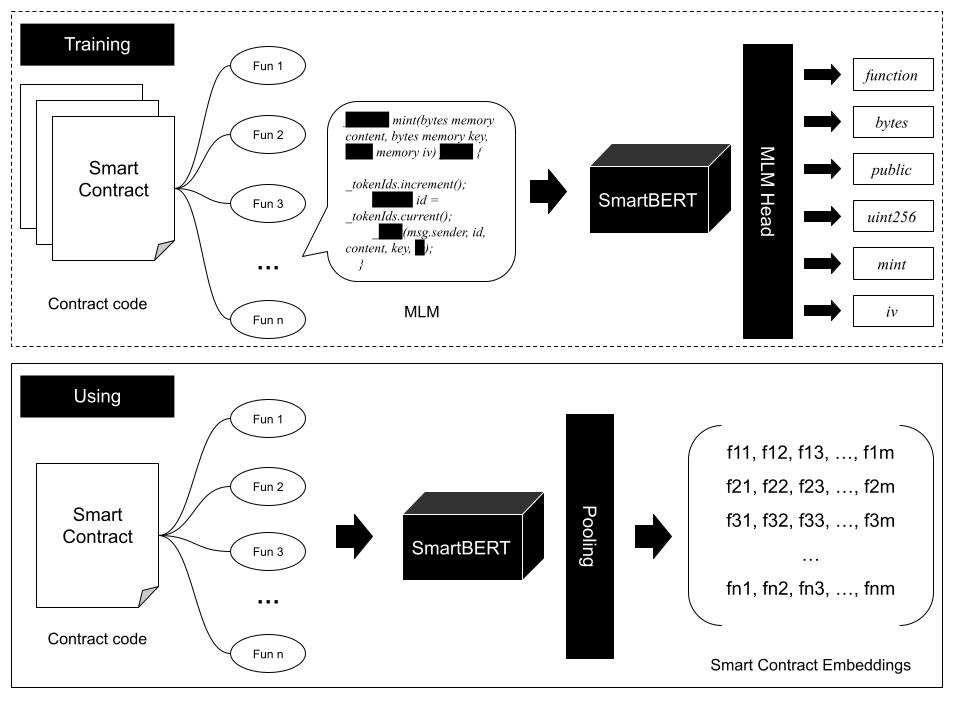
SmartBERT V3 is a domain-adapted pre-trained programming language model for smart contract code understanding, built upon CodeBERT-base-mlm.
The model is further trained on SmartBERT V2 with a substantially larger corpus of smart contracts, enabling improved robustness and richer semantic representations of function-level smart contract code.
SmartBERT V3 is particularly suitable for tasks such as:
Compared with SmartBERT V2, this version significantly expands the training corpus and improves the model’s ability to capture semantic patterns in smart contract functions.
SmartBERT V3 was trained on a total of 80,000 smart contracts, including:
All contracts are primarily written in Solidity and processed at the function level to better capture fine-grained semantic structures of smart contract code.
The model is trained using the Masked Language Modeling (MLM) objective, following the same training paradigm as CodeBERT.
During training:
This process enables the model to learn deeper syntactic and semantic representations of smart contract programs.
Training was conducted using the HuggingFace Transformers framework.
Example training configuration:
training_args = TrainingArguments(
  output_dir=OUTPUT_DIR,
  overwrite_output_dir=True,
  num_train_epochs=20,
  per_device_train_batch_size=64,
  save_steps=10000,
  save_total_limit=2,
  evaluation_strategy="steps",
  eval_steps=10000,
  resume_from_checkpoint=checkpoint
)
During preprocessing, all newline (\n) and tab (\t) characters in the function code were replaced with a single space to ensure a consistent input format for tokenization.
SmartBERT V3 builds upon the following models:
Example usage with HuggingFace Transformers:
from transformers import RobertaTokenizer, RobertaForMaskedLM, pipeline

model = RobertaForMaskedLM.from_pretrained('web3se/SmartBERT-v3')
tokenizer = RobertaTokenizer.from_pretrained('web3se/SmartBERT-v3')

code_example = "function totalSupply() external view <mask> (uint256);"
fill_mask = pipeline('fill-mask', model=model, tokenizer=tokenizer)

outputs = fill_mask(code_example)
print(outputs)
To train and deploy the SmartBERT V3 model for Web API services, please refer to our GitHub repository: web3se-lab/SmartBERT.
@article{huang2025smart,
  title={Smart Contract Intent Detection with Pre-trained Programming Language Model},
  author={Huang, Youwei and Li, Jianwen and Fang, Sen and Li, Yao and Yang, Peng and Hu, Bin},
  journal={arXiv preprint arXiv:2508.20086},
  year={2025}
}
Base model
microsoft/codebert-base-mlm